The Reality Check: Where Does the Commission Stand Right Now?
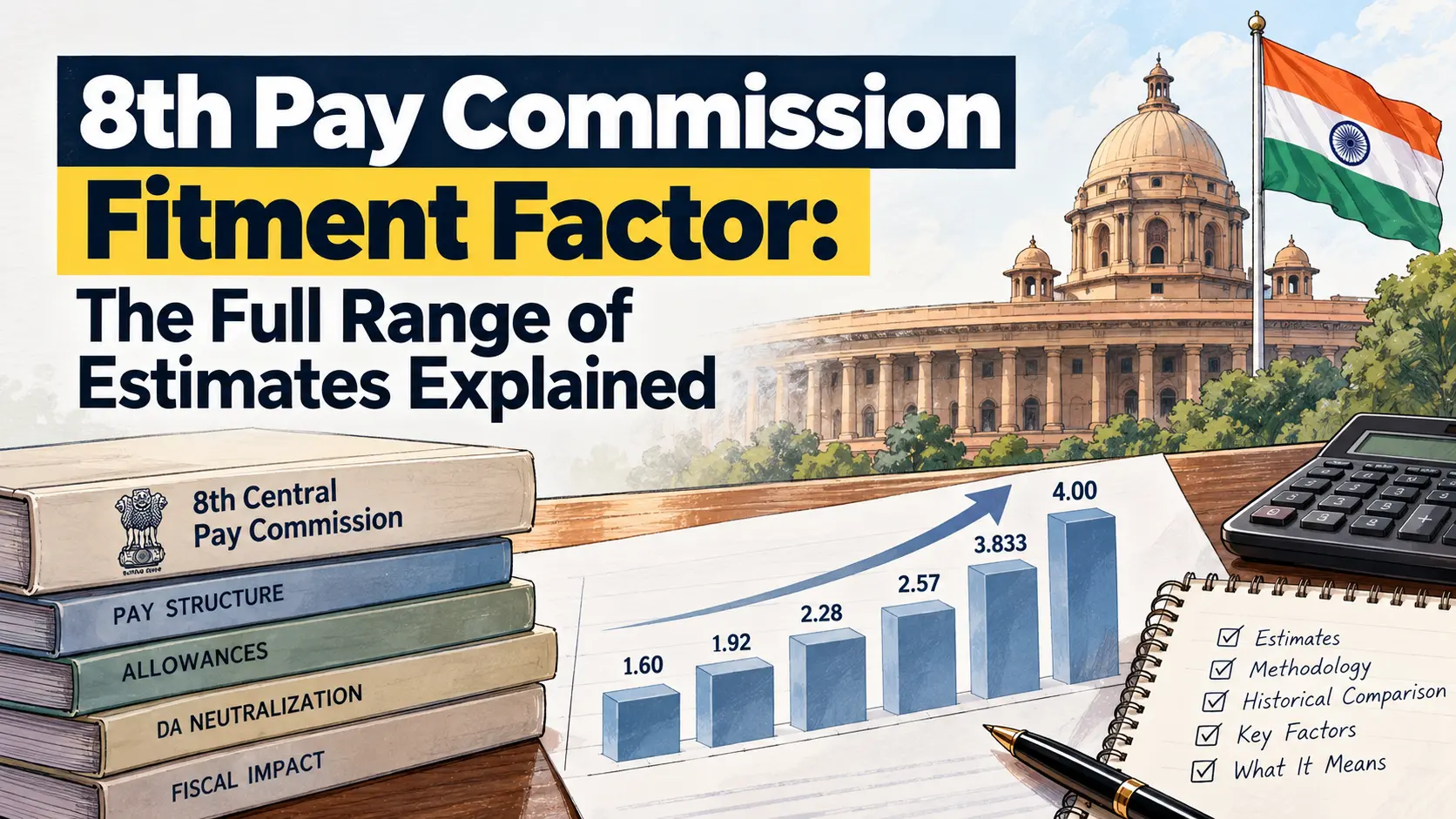
If you have opened social media lately, you have probably seen claims that the government has finalized an 8th Pay Commission fitment factor. Some videos promise a 1.92 multiplier. Others insist on 2.57 or celebrate a guaranteed 3.833 hike.
Here is the ground truth as of late September 2026: the 8th Central Pay Commission has not recommended, approved, or notified any fitment factor or pay matrix. It has not set a minimum wage. The Commission, headed by former Supreme Court Judge Justice Ranjana Prakash Desai, was formally constituted on 3 November 2025. It has an 18-month reporting window that runs until May 2027.
Right now, the Commission is traveling for regional hearings, including visits to Puducherry, Chandigarh, Bengaluru, and Mumbai. The wide spread of numbers in the news is not a leak of a secret decision. It is a mix of union demands, past precedents, and economic models. Understanding which is which makes all the difference. For a broader look at salary concepts, you can check our fitment factor plain language guide.
1. What Is a Fitment Factor, and What Does It Actually Do?
The basic mechanics of turning an old pay slip into a new pay matrix scale.
Think of the fitment factor as a bridge between two decades. In the central government, pay scales are revised roughly once every ten years. In between, prices keep rising. To protect purchasing power, the government pays Dearness Allowance (DA), which updates every six months based on consumer inflation.
Over a decade, that DA builds up into a massive percentage. When a new Pay Commission steps in, it wipes the slate clean. Accumulated DA drops to zero, and its cash value is rolled directly into your basic pay. But simply folding in DA leaves you right where you started in terms of buying power. That is why a Pay Commission adds a separate real wage increase on top.
The Two Halves of Every Fitment Multiplier
Remember: the fitment factor applies strictly to basic pay. It does not multiply your allowances, and it does not equal the percentage growth in your net take-home salary.
2. The DA Reset Trap: Why 2.57 Is Not What You Think
Why repeating the 7th CPC multiplier today would mean something completely different.
The 2016 vs. 2026 Comparison
Many people believe that because the 7th Pay Commission gave a fitment factor of 2.57, the 8th Pay Commission must grant 2.57 or higher to be fair. That sounds logical on the surface. But mathematically, it completely overlooks how much Dearness Allowance was absorbed.
2.25 × 1.142857 = 2.57.
(2.57 ÷ 1.60) − 1 = 60.63% real growth!
A 60.6% real increase over basic-plus-DA would be more than four times larger than what the 7th CPC delivered. That is why budget analysts consider an exact 2.57 repeat unlikely.
Lower Multipliers Can Still Mean Bigger Raises
Because the starting DA base is lower this time around, a smaller headline fitment number can actually deliver a larger real salary hike than what civil servants received in 2016:
3. Comparing the Full Spectrum of Fitment Estimates
How circulating numbers translate into real wage increases over the 60% DA baseline.
Implied Real Wage Increase by Fitment Factor
Assuming 60% Dearness Allowance merged on 1 January 2026.
| Fitment Factor | What It Represents | Implied Real Raise (over 60% DA) | Level 1 Basic Pay | Source & Status |
|---|---|---|---|---|
| 1.60 | Pure DA merger only | 0.0% | ₹28,800 | Mathematical floor (Unlikely) |
| 1.92 | 60% DA + 20% real raise | +20.0% | ₹34,560 | Conservative analyst model |
| 2.00 | 60% DA + 25% real raise | +25.0% | ₹36,000 | Hypothetical round-number model |
| 2.15 | 60% DA + 34.4% real raise | +34.4% | ₹38,700 | Moderate media commentary scenario |
| 2.28 | 60% DA + 42.5% real raise | +42.5% | ₹41,040 | Popular compromise estimate |
| 2.57 | Direct copy of 7th CPC multiplier | +60.6% | ₹46,260 | Historical benchmark (Unofficial) |
| 2.86 | Targeting ~₹51,500 basic | +78.8% | ₹51,480 | Regional union demand / online calculators |
| 3.833 | Ratio of ₹69,000 to ₹18,000 | +139.6% | ₹69,000 | Formal NC-JCM Memorandum Demand |
| 4.00 | Ratio of ₹72,000 to ₹18,000 | +150.0% | ₹72,000 | BPMS Defence Federation Demand |
4. Behind the Scenes: How Did Unions Arrive at 3.833?
The living wage formula, dietary standards, and family units behind the ₹69,000 demand.
The 3.833 multiplier is not a random number made up for social media. It comes straight from a 51-page Common Memorandum submitted to the 8th Pay Commission on 14 April 2026 by the Staff Side of the National Council of the Joint Consultative Machinery (NC-JCM), signed by Secretary Shiva Gopal Mishra. You can read the coverage of the NC-JCM minimum basic pay submission as reported in news analysis.
The Staff Side did not pick 3.833 out of thin air. Instead, they built a bottom-up budget for what an entry-level worker needs to survive with dignity, reaching a target of ₹69,000. Dividing ₹69,000 by the current Level 1 minimum pay of ₹18,000 produces exactly 3.833.
Three Big Shifts in the Union Formula
Past Pay Commissions used a standard family of 3 units (the worker, spouse, and two young children). The NC-JCM argued this is outdated. Citing legal duties to care for aging parents under the Senior Citizens Act, they expanded the formula to include two dependent parents. That change alone pushes the baseline expenditure up by 66.7% before counting a single rupee of inflation.
Instead of the standard 2,700 kcal intake per day used in earlier rounds, the submission applied the Indian Council of Medical Research (ICMR) benchmark for heavy physical labor (3,490 kcal), increasing food basket costs.
Relying on Supreme Court minimum wage rulings, the unions added a 25% allowance for children's education and another 25% buffer for social obligations, ceremonies, and recreation.
Details of the demand are available in the NC-JCM memorandum summary. While these arguments highlight genuine family expenses, the government balances them against state revenues, infrastructure budgets, and pension payouts under both old and new frameworks. Similar debates over pension formulas are unfolding across defence circles, as explored in our piece on 8th Pay Commission pension changes.
5. What the Different Factors Do to Starting Pay
Visualizing entry-level Level 1 monthly basic pay under each circulating scenario.
Starting Basic Salary Comparison (Level 1 Entry)
Current baseline is ₹18,000 per month (7th CPC Level 1).
6. Pay Matrix Fixation: Why Simple Multiplication Is Wrong
How administrative rounding into matrix cells changes your actual salary increase.
Most salary calculators on the internet do one simple thing: they take your basic pay, multiply it by a fitment number, and call it your new salary. In actual government accounting, it does not work like that.
Take an employee in Level 7 with a 6th CPC basic pay of ₹20,500. Multiplying ₹20,500 by the 2.57 fitment factor gave ₹52,685. But when you opened the Level 7 column in the new Pay Matrix, there was no cell for ₹52,685. The closest cells were ₹51,100 and ₹53,600.
Under fixation rules, the employee was moved upward to ₹53,600. That administrative step added an extra ₹915 per month on top of the bare multiplication math. Because the 8th Pay Commission has not published a draft pay matrix yet, exact cell fixations cannot be calculated for anyone right now.
7. What the Fitment Factor Does NOT Decide
Allowances, deductions, and why take-home pay behaves differently.
Allowances Follow Separate Rules
Your fitment factor sets only your basic pay. Allowances like House Rent Allowance (HRA) and Transport Allowance (TA) do not automatically scale by the same multiplier.
- HRA: Tied to city categories (X, Y, Z). The commission reviews HRA rates separately under its terms.
- TA: Paid as fixed financial slabs by grade and city tier, adjusted for prevailing DA. It has its own schedule.
Deductions and Tax Slabs Rise Too
A higher basic pay brings higher monthly deductions. Your mandatory pension contribution under NPS or the Unified Pension Scheme (10% of Basic + DA) grows automatically with basic pay.
- Income Tax: Higher gross earnings can push you into higher tax brackets under the New Tax Regime.
- Net In-Hand: Take-home salary increases by a noticeably smaller percentage than the headline basic pay jump.
8. Illustrative Basic Pay Across Common Pay Levels
Seeing how different multipliers affect baseline salary across representative pay grades.
| Pay Level & Post | 7th CPC Base | At 1.92 | At 2.28 | At 2.57 | At 2.86 | At 3.833 (Union) |
|---|---|---|---|---|---|---|
| Level 1 (MTS / Entry) | ₹18,000 | ₹34,560 | ₹41,040 | ₹46,260 | ₹51,480 | ₹69,000 |
| Level 2 (LDC / Postman) | ₹19,900 | ₹38,208 | ₹45,372 | ₹51,143 | ₹56,914 | ₹76,277 |
| Level 4 (UDC / Head Constable) | ₹25,500 | ₹48,960 | ₹58,140 | ₹65,535 | ₹72,930 | ₹97,742 |
| Level 6 (Inspector / Teacher) | ₹35,400 | ₹67,968 | ₹80,712 | ₹90,978 | ₹1,01,244 | ₹1,35,688 |
| Level 7 (Section Officer / Sub-Inspector) | ₹44,900 | ₹86,208 | ₹1,02,372 | ₹1,15,393 | ₹1,28,414 | ₹1,72,102 |
| Level 10 (Group A Entry / SDM) | ₹56,100 | ₹1,07,712 | ₹1,27,908 | ₹1,44,177 | ₹1,60,446 | ₹2,15,031 |
9. Sorting Fact from Fiction
Clearing up five widespread misconceptions about fitment calculations.
"A 2.57 fitment factor means your take-home pay grows by 157%."
Fact: False. The 2.57 factor under the 7th CPC rolled in 125% of accumulated Dearness Allowance that employees were already taking home every month. The actual real wage increase was only 14.29%.
"The government has officially approved a minimum salary of ₹34,560 or ₹51,480."
Fact: Neither number has been approved. ₹34,560 is simply what you get if you multiply ₹18,000 by 1.92. ₹51,480 is the product of multiplying by 2.86. They are theoretical calculator outputs, not official decisions.
"The 8th Pay Commission must give a higher multiplier than 2.57 to be fair."
Fact: Because DA was 60% on 1 January 2026 (instead of 125% in 2016), granting 2.57 today would mean an unprecedented 60.6% real wage increase. A factor of 2.28 would give a 42.5% real raise, far larger than the 7th CPC's raise.
"The 3.833 fitment factor has already been recommended by the panel."
Fact: 3.833 is a formal demand submitted by employee unions through the NC-JCM memorandum. It represents the staff side's opening negotiating position, not a government-approved figure or commission recommendation.
"You can calculate your new salary by multiplying your total current pay."
Fact: The fitment factor applies only to basic pay. DA resets to 0% at transition, while HRA, TA, and other allowances follow separate rules and slabs. Multiplying gross salary yields an inflated, incorrect figure.
10. Frequently Asked Questions
Direct answers to common questions about the 8th CPC fitment factor.
Official Sources and Public Records
The analysis in this guide is derived directly from government gazettes, union memoranda, and published proceedings as of 28 September 2026:
The Bottom Line
When you see sensational claims about the 8th Pay Commission fitment factor, keep two facts in mind. First, the 3.833 multiplier is an employee union demand, while figures between 1.92 and 2.28 represent economic models from analysts. Second, because Dearness Allowance stood at 60% on 1 January 2026, a multiplier that looks smaller on paper can still deliver a very healthy real wage increase. The Commission has until May 2027 to balance living expenses with national finances, and until its formal report is released, every specific number remains an estimate.