Ask ten teachers what the 8th Pay Commission means for their salary and you’ll probably get ten different answers. A Kendriya Vidyalaya teacher in Bhopal, a government school teacher in Bihar, and an assistant professor at a private college in Pune are all “teachers” in the everyday sense. When it comes to this Commission, though, they’re in three completely different situations. And one of them isn’t really in the picture at all.
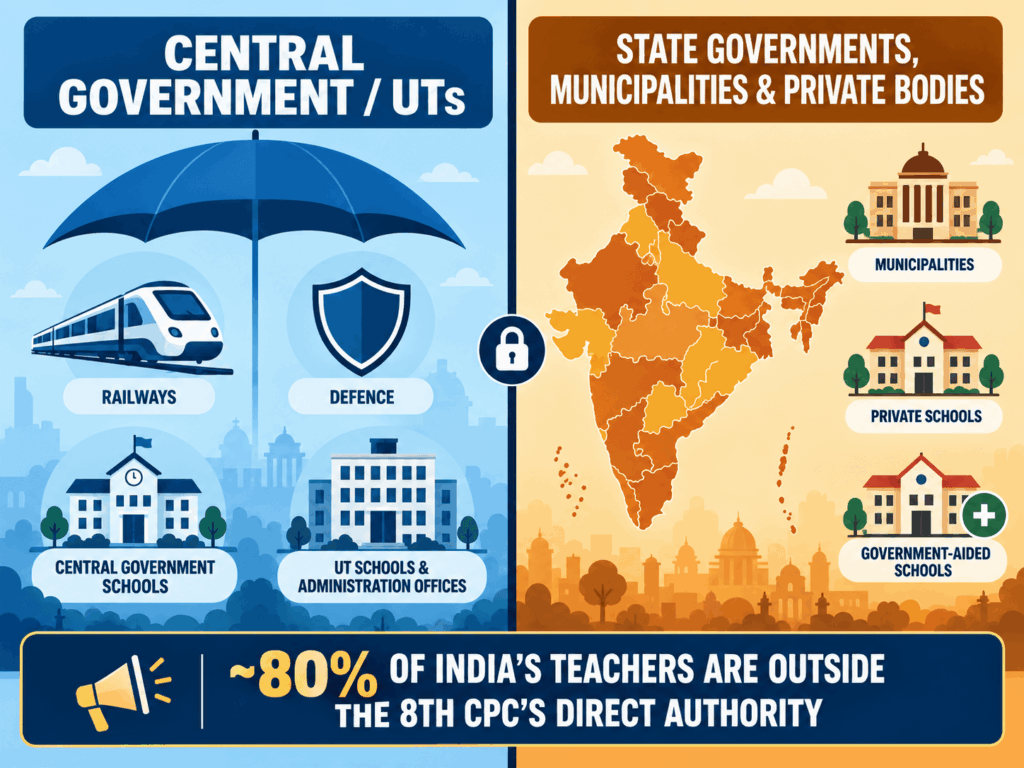
That mix-up is the biggest source of confusion right now, and it’s worth getting right. A large majority of India’s teachers work for state governments, municipal bodies, aided institutions, or private managements, and the 8th Central Pay Commission doesn’t directly determine pay for any of them. Here’s what’s actually covered, what isn’t, and why.
The divide that decides everything: Central vs. State
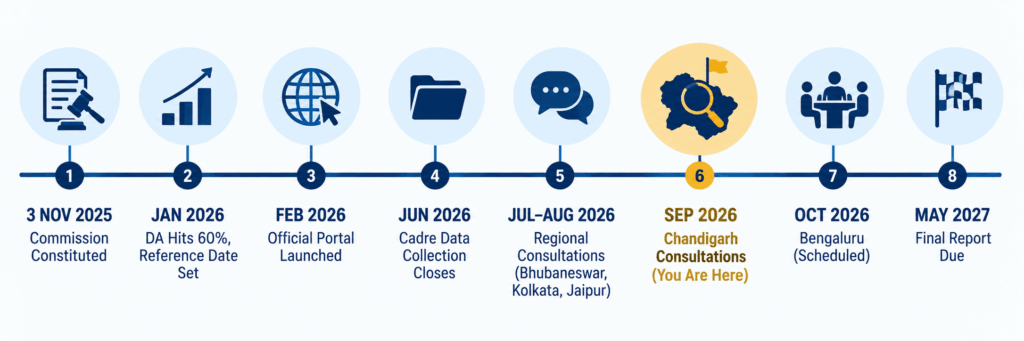
The 8th Central Pay Commission was formally set up on 3 November 2025, chaired by retired Supreme Court judge Justice Ranjana Prakash Desai, with Prof. Pulak Ghosh of IIM Bangalore and Pankaj Jain rounding out the three-member panel. Its job, as laid out in the government’s own terms of reference, covers regular Union government staff, Union Territory employees, the All India Services, and the defence forces. Teachers aren’t listed as their own category anywhere in there. They only fall inside it if their actual employer happens to be one of those bodies, say, a school run by the Railways or the Defence Ministry.
Most teachers’ employer isn’t the Union government. It’s their state. Under India’s constitutional setup, pay and service conditions for state government employees are governed by that state government’s own rules and decisions, subject to the Constitution and applicable laws.
A Central Pay Commission recommendation doesn’t automatically change those rules; the state has to choose to adopt it, in full, in part, or with modifications. This isn’t a loophole either; it’s happened, consistently, every single time a Pay Commission has reported.
After the 7th CPC’s report came out in 2016, plenty of states didn’t get around to issuing their own adoption orders until 2018 or 2019, and some paid arrears only from a later date instead of backdating them the way the centre did. We’ve gone into this pattern in more depth in our piece on state government employees, because honestly, it deserves its own explainer.
Who’s actually covered: cadre by cadre
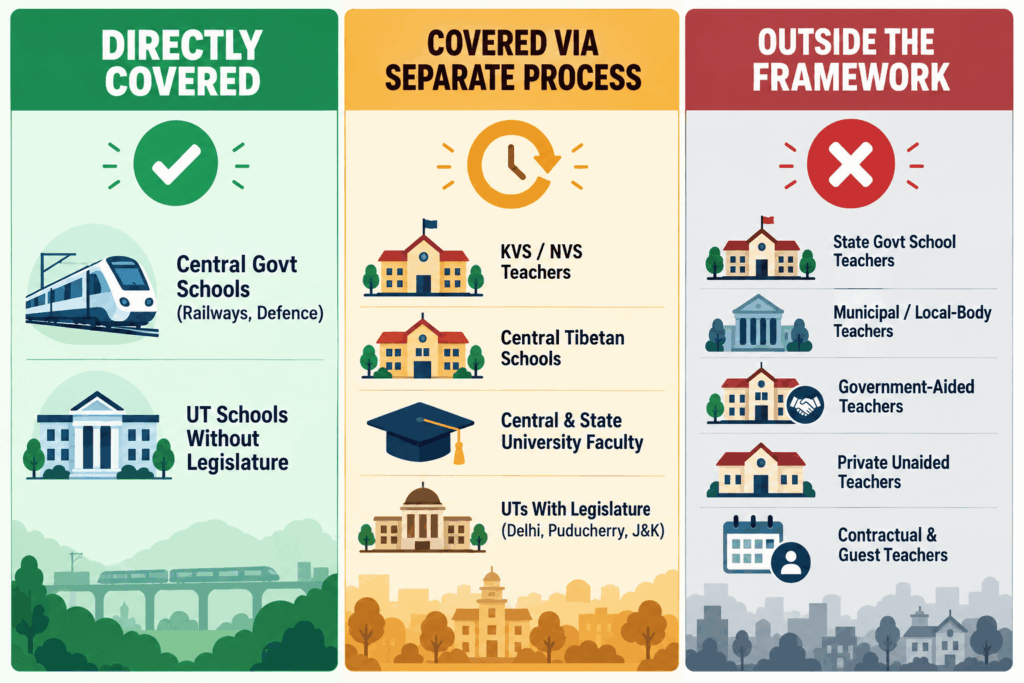
Once you sort teachers by who actually employs them, the picture gets a lot clearer.
| Teacher category | Status | What has to happen for pay to change |
|---|---|---|
| Central government schools (Railways, Defence, Ordnance Factory schools) | Directly covered | Applied once the government accepts the Commission’s recommendations and issues the revised pay rules |
| Kendriya Vidyalaya (KVS) & Navodaya Vidyalaya (NVS) | Covered, but not automatic | Needs a separate Finance Ministry order, then sign-off from KVS/NVS’s own governing board |
| Central Tibetan Schools Administration | Covered, but not automatic | Similar extension order through the Education Ministry |
| Central university & UGC faculty (Assistant/Associate Professors, etc.) | Covered through a separate track | UGC and the Education Ministry have historically built a separate academic pay structure after a Pay Commission reports; no such committee has been announced yet for the 8th CPC |
| State university & college faculty | Outside the direct framework | Depends on the state adopting the UGC’s scale, often years later, sometimes with the centre offering to fund part of it temporarily |
| UT schools without their own legislature (Chandigarh, Andaman & Nicobar, Ladakh) | Directly covered | Same route as central departmental staff |
| UTs with legislatures (Delhi, Puducherry, J&K) | Usually aligned | Local administration issues its own order; Delhi additionally has a 1973 law forcing recognised private schools to match government pay |
| State government school teachers | Outside the direct framework | Entirely up to that state’s own pay commission or cabinet decision |
| Municipal / local-body teachers | Outside the direct framework | Tied to municipal budgets and state urban development orders |
| Government-aided school teachers | Outside directly, but often gets parity eventually | Only after the state revises its own scales and updates the grant-in-aid formula |
| Private unaided school teachers | Outside the framework | No automatic right, except where a specific state law forces parity (Delhi being the clearest example) |
| Contractual, guest & Samagra Shiksha teachers | Outside the framework entirely | Pay Commissions only deal with regular, permanent posts; these teachers get fixed honoraria set by state project bodies |
A quick note on the armed forces line: defence teaching staff sit inside the Commission’s remit, but military compensation also runs through a separate pension arrangement called OROP that works alongside, not instead of, Pay Commission rules. We’ve broken that down separately in our OROP explainer if that’s relevant to you.
The KVS and NVS row is worth sitting with for a second, because it trips people up both ways. They’re not direct government employees (legally, they’re staff of autonomous societies), so the Commission’s recommendations don’t apply to them automatically the moment they’re notified.
KVS and NVS have historically followed Central Pay Commission-linked pay structures through separate administrative decisions, once the Finance Ministry issues the necessary order and the KVS Board or NVS executive committee formally adopts it. That’s different from saying the 8th CPC automatically applies to them. So “not directly covered” doesn’t mean “left out.” It means there’s an extra administrative step in between.
University teaching is its own animal entirely. The 8th CPC’s remit, per its terms of reference, is the general civilian pay matrix, full stop. It isn’t evaluating research output, academic grades, or teaching designations. In the last two cycles, that gap was filled by a separate Pay Review Committee that the UGC and the Education Ministry (then the HRD Ministry) set up after the main report landed: the Chadha Committee following the 6th CPC, and the Chauhan Committee following the 7th.
No equivalent committee has been constituted for the 8th CPC yet, so this is historical precedent rather than a guaranteed template. Last time round, the Chauhan Committee submitted its recommendations in early 2017, more than a year after the 7th CPC’s own report landed, and the Cabinet approved the revised faculty scales in October 2017.
If a similar process is set up again this cycle, university teachers could be looking at a longer wait than most other central employees, not a shorter one, but that’s a pattern to watch for, not a confirmed timeline.
Where things actually stand right now
As of mid-September 2026, here’s what’s confirmed and what isn’t. Ministries and departments were originally asked to submit cadre and pension data by 30 June 2026; that deadline was extended to 31 July 2026, and the Commission has continued asking departments for additional cadre-level detail (through a separate Annexure-L data field) into August and September. So data collection is well advanced but doesn’t appear to be fully wrapped up.
The Commission is also in the middle of a run of regional consultations: Bhubaneswar and Kolkata in July, Jaipur in late August, Puducherry in early September, and Chandigarh from 16 to 18 September, with Bengaluru scheduled for early October. None of that is the same as a decision. The panel has an 18-month window from its constitution date to submit its final report, which puts the deadline around May 2027.
We keep a running list of every confirmed milestone, updated as they happen, on our key dates page. It’s worth bookmarking if you want to track this without wading through news every week.
The fitment factor: guesses vs. facts
This is where most of the confusion lives, so here’s the plain fact: no fitment factor has been decided. Not by the Commission, not by the Finance Ministry. Anyone quoting you a specific number as if it’s final is quoting a demand, an estimate, or a guess, not a decision.
Here’s the one number that actually is fixed: the reference date for this pay revision is 1 January 2026, and Dearness Allowance under the current 7th CPC scales stood at 60% on that date. That gives a simple illustrative 1.60 multiplier, equivalent to adding the current 60% DA rate to basic pay, useful for seeing how the math works, but not an official fitment factor.
If the Commission eventually recommends anything above 1.60, that portion is the real increase; a recommendation at exactly 1.60 would mean take-home pay barely moves, because the allowance would simply have been renamed as basic pay. If any of these terms feel unfamiliar, our glossary post walks through fitment factor, pay matrix, and DA merger in plain language.
What’s floating around publicly is a wide spread of proposals. The central employee unions’ joint staff council has pushed for a factor of 3.83, aiming for a minimum basic pay around ₹69,000. The Pragatisheel Shikshak Nyaya Manch, which represents central and UT school teachers specifically, submitted its own memorandum in April 2026 asking for something similar: a fitment factor between 2.62 and 3.83, alongside faster promotions and a higher retirement age. Financial analysts, on the other end, tend to think the fiscally realistic range sits closer to 1.92–2.28. All three of those are proposals or projections, not decisions, and none of them is policy.
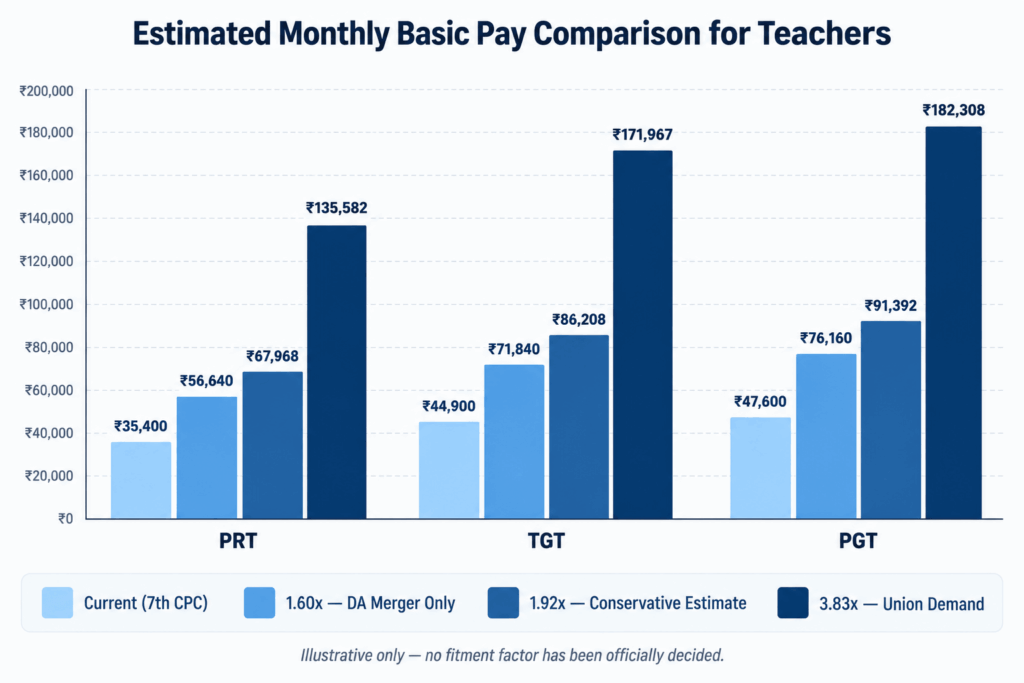
To make the math concrete (and only as an illustration), here’s what a few different multipliers would do to entry-level teaching pay, starting from current 7th CPC basic pay:
| Post | Current basic (7th CPC) | At 1.60x (illustrative DA-merger multiplier) | At 1.92x (conservative estimate) | At 3.83x (union demand) |
|---|---|---|---|---|
| Primary Teacher (PRT) | ₹35,400 | ₹56,640 | ₹67,968 | ₹135,582 |
| Trained Graduate Teacher (TGT) | ₹44,900 | ₹71,840 | ₹86,208 | ₹171,967 |
| Post Graduate Teacher (PGT) | ₹47,600 | ₹76,160 | ₹91,392 | ₹182,308 |
These are mechanical calculations to show how the math works, not predictions. Treat every number in that table as a hypothetical until an actual report exists.
Mythbusting: the claims teachers keep hearing
“The 8th CPC will automatically raise every teacher’s salary in India.” False. Central Pay Commissions don’t directly set pay for state, municipal, or private employers, and that’s most of India’s teachers.
“KVS and NVS teachers are outside the 8th CPC entirely.” Misleading. They’re not direct government employees, but they’ve historically followed Central Pay Commission-linked scales once the right administrative orders are issued by the Finance Ministry and their own governing bodies. It’s an extra step, not an exclusion.
“A fitment factor has already been finalised.” False. As recently as July 2026, the Finance Ministry told the Rajya Sabha in a written reply that the Commission isn’t even required to brief the government on what it’s considering, let alone announce numbers mid-process.
“University professors’ pay will be decided directly by the 8th CPC.” False. It sets the general civilian scale; historically, a separate UGC-constituted committee has translated that into academic pay levels afterward, usually with a lag of a year or more, though no such committee has been set up for this cycle yet.
“Private school teachers will benefit automatically.” False, with one notable exception. Delhi’s School Education Act legally requires recognised private schools to match government pay: a rule that’s been upheld and enforced through the courts, though not without long, messy fights over back pay. Outside states with a similar law, there’s no such obligation.
“Contractual and guest teachers will get the new pay scales.” False. Pay Commissions only touch permanent, sanctioned posts. Contractual and Samagra Shiksha teachers are paid fixed honoraria set by state-level bodies, and none of this changes that.
What this actually means for you
If you’re a teacher trying to figure out where you stand, start with one question: who signs your paycheck? If it’s a central ministry, a UT administration, KVS, or NVS, this Commission’s work will eventually reach you, though for KVS and NVS staff that means waiting on a second round of paperwork after the main report lands. If it’s a state government, a municipality, an aided trust, or a private management, the 8th CPC’s report is background information at best. Your actual raise, if one comes, will be decided at the state level, on the state’s own timeline.
Either way, nothing changes your salary today. The report isn’t due until roughly May 2027, and even then, Cabinet approval and department-level orders typically take several more months after that. Once real numbers exist instead of proposals, our calculator will let you see exactly what they mean for your own pay level. There’s no rush, though. For now, the only thing worth doing is knowing which line you’re standing in.
Leave a Reply