
Last checked: 4 October 2026. DA and the consultation schedule can change after publication.
Search for the 8th Pay Commission and you will find big numbers. A fitment factor of 3.83. A minimum pay of ₹69,000. Salaries “doubling”. Almost all of these are either demands from employee organisations or somebody’s arithmetic. The position on 4 October 2026 is simpler.
The Commission is real and actively working. It has not submitted any recommendations, and the government has not decided a fitment factor, a minimum pay or an implementation date. This article keeps those categories apart, so you can tell a fact from a demand from an illustration.
Where the Commission stands today
The government announced the Commission in January 2025. The Cabinet approved its terms of reference on 28 October 2025, and the Department of Expenditure formally constituted it by a resolution dated 3 November 2025. Justice Ranjana Prakash Desai, a former Supreme Court judge, is the chair. Prof. Pulak Ghosh of IIM Bangalore is the part-time member and Pankaj Jain is the member-secretary.
It has 18 months from constitution to report, which points to around May 2027. The terms of reference allow interim reports, but none has been reported so far.
In a Lok Sabha reply on 10 August 2026, the Minister of State for Finance said the Commission has not yet submitted its recommendations. A second reply the same day said the resolution does not require the Commission to keep the government updated on its consultations. I found nothing newer from an official source, and press coverage as late as 1 October 2026 still reports no official fitment factor, minimum pay or pension decision.
Consultations. The Commission ran an online questionnaire earlier this year, and the deadline for written memoranda was extended to 15 June 2026. Its official notices scheduled visits to Ladakh, Lucknow, Bhubaneswar, Kolkata, Delhi (7 and 10 August), Jaipur (31 August to 1 September), Chennai (7 to 8 September), Puducherry (9 September) and Chandigarh (16 to 18 September). Two are still ahead: Bengaluru on 7 and 8 October, and Mumbai on 22 and 23 October 2026. Organisations wanting to meet the Commission in Mumbai had to request appointments by 10 October. The website publishes notices, not records of what was said, so “scheduled” does not prove “held”. Check the site for changes.
Who is covered, and which number to use. Different figures describe different groups.
- The government told the Lok Sabha on 10 August 2026 that there are about 35.77 lakh civilian Central Government employees (as of 1 March 2026) and 33.76 lakh civilian pensioners and family pensioners (as of 31 December 2025). The pensioner figure excludes defence pensioners.
- When the terms of reference were approved, the government spoke of roughly 50 lakh employees, defence personnel included, and about 69 lakh pensioners. These include defence, so do not compare them with the civilian figures.
- The April 2026 DA decision used yet another count: 50.46 lakh employees and 68.27 lakh pensioners who receive DA and DR. That is a payroll count, not the Commission’s coverage.
This is a Central Government exercise. Bank and PSU wages follow a separate route, which our guide to bank and PSU employee salary revisions explains. State governments decide their own pay, and the terms of reference ask the Commission to weigh effects on state finances. If you work for a state, see whether the 8th Pay Commission raises state government salaries. For teachers, much depends on whether the institution is central or state-run.
What is confirmed and what is not
| Item | Status on 4 October 2026 |
|---|---|
| Commission constituted, chair and members named | Officially confirmed |
| 18-month reporting period | Officially confirmed |
| Recommendations submitted | No |
| Interim report | Allowed by the terms of reference; none reported |
| Fitment factor | Not decided. No recommendation exists yet |
| Minimum basic pay | Not decided. ₹18,000 continues |
| Implementation date | Not decided |
| DA for the July 2026 revision | Pending. No Cabinet announcement found |
| Pay matrix, HRA and other allowances | Current rules continue |
| Figures such as 3.833 or ₹69,000 | Employee organisation demands only |
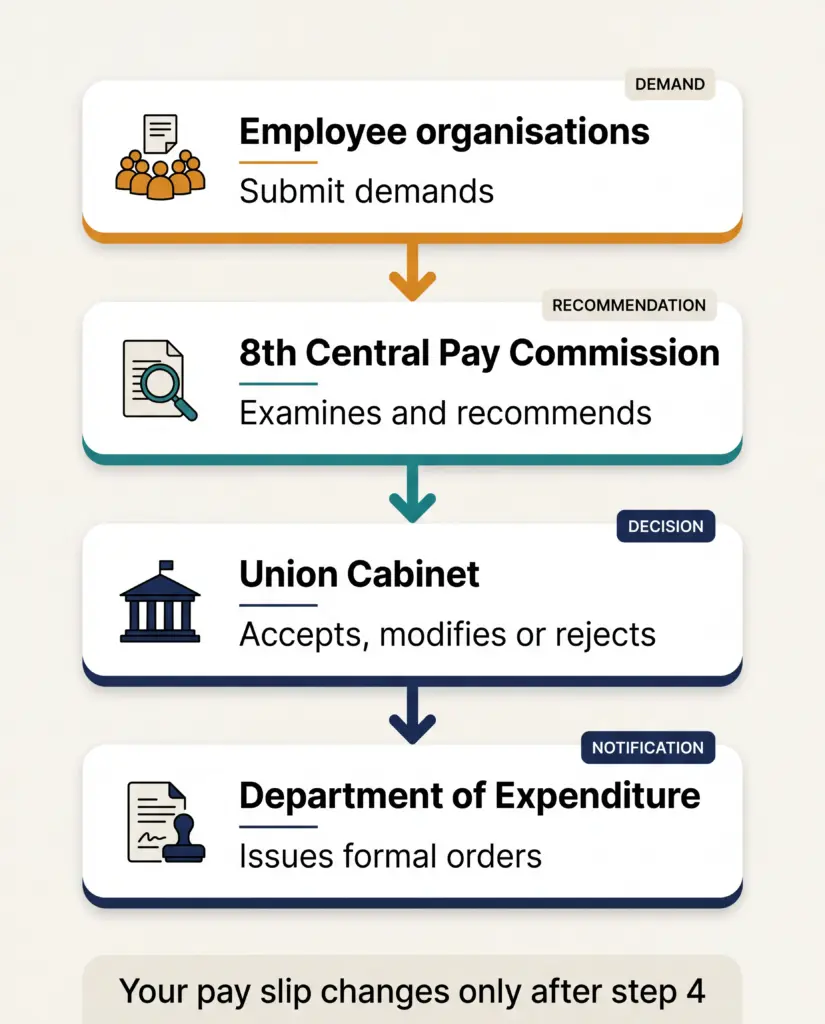
Employee organisations can submit demands. They cannot decide the pay structure. The Commission only recommends. The government can accept, modify or reject what it recommends, and nothing becomes policy until it is formally notified.
The fitment factor in plain language
The fitment factor is a multiplier applied to basic pay to arrive at a starting pay in a new pay matrix.
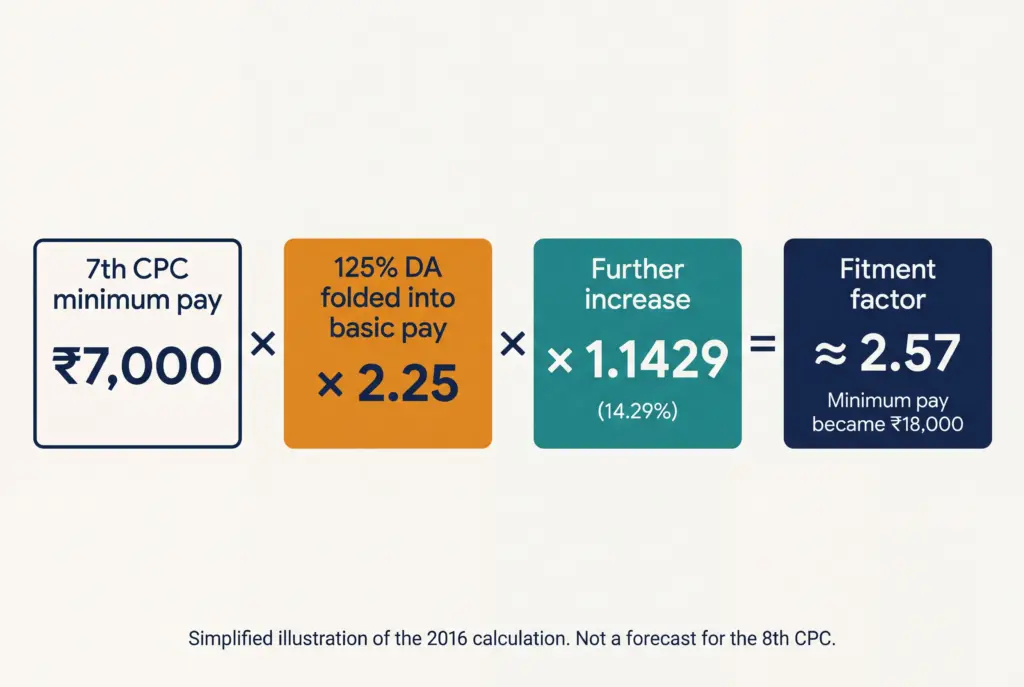
The last time, minimum pay went from ₹7,000 to ₹18,000, a factor of 2.57. It had two parts. The 125% dearness allowance (DA, the cost-of-living top-up on basic pay) was folded into basic pay, which is a multiplier of 2.25. Then a further 14.29% was added: 2.25 × 1.1429 gives about 2.57. The Finance Ministry’s instructions of July 2016 confirm that the revised pay included the 125% DA.
A caution. Multiplying basic pay by a single number is only a simple illustration. In 2016 the multiplied figure was matched to a cell in the new matrix, with the next higher cell used where there was no exact match. A future commission could use a different matrix, rounding rules, stages or another method. Do not treat the tables below as a way to calculate a future pay slip.
Employee and union demands
More than one organisation has put forward a number, and they differ.
| Organisation | Demand | Status |
|---|---|---|
| NC-JCM (staff side) | Fitment factor 3.833, minimum pay about ₹69,000 | Memorandum, April 2026 |
| NFIR | ₹69,000 minimum, factor 3.83 | Reported May 2026 |
| BPMS (defence civilian employees) | Factor 4.00, minimum ₹72,000 | Draft memorandum dated 16 April 2026 |
| IRTSA | Graduated factors from 2.92 (Levels 1 to 5) to 4.38 (Levels 17 and 18), minimum ₹52,600 | Presentation, 2026 |
The NC-JCM figure follows from 18,000 × 3.833 = ₹68,994. It also asks for HRA at 40%, 35% and 30% and for more frequent career upgrades (see the MACP section below). All of these are demands. The Commission has not said it will accept any of them.
Estimates from analysts and the media also circulate. This article does not repeat any without a traceable source, and the Commission has issued none. For a wider look at how people arrive at their numbers, see our fitment factor explainer.
What different hypothetical factors would do to basic pay
This table is a hypothetical illustration, not a forecast. The factor 2.57 is the 7th CPC figure, 3.833 is the NC-JCM demand, and 2.00 is a round number for comparison. Amounts are rounded to the nearest rupee.
| Level (example post) | Basic pay now | × 2.00 | × 2.57 | × 3.833 |
|---|---|---|---|---|
| Level 1 (Multi-Tasking Staff) | ₹18,000 | ₹36,000 | ₹46,260 | ₹68,994 |
| Level 4 (Tax Assistant) | ₹25,500 | ₹51,000 | ₹65,535 | ₹97,742 |
| Level 7 (Inspector) | ₹44,900 | ₹89,800 | ₹1,15,393 | ₹1,72,102 |
| Level 10 (Assistant Commissioner) | ₹56,100 | ₹1,12,200 | ₹1,44,177 | ₹2,15,031 |
If you want to try other factors against your own level, the 8th Pay Commission salary calculator lets you do that.
Why a large factor does not mean take-home pay doubles
When a new pay structure starts, DA has traditionally been absorbed into basic pay and restarted from zero, as in 2016. The 8th Commission has not decided this. If it happens again, much of the “increase” only replaces what you already receive.
Take a Level 1 employee. Basic pay of ₹18,000 plus 60% DA (₹10,800) is already ₹28,800 a month.
| Hypothetical factor | New basic pay | Change from ₹28,800 |
|---|---|---|
| 2.00 | ₹36,000 | +25.0% |
| 2.28 | ₹41,040 | +42.5% |
| 2.57 | ₹46,260 | +60.6% |
| 3.833 | ₹68,994 | +139.6% |
This ignores HRA, transport allowance, deductions and tax. The starting point also depends on the DA rate when any new structure begins. A higher DA means a higher base.
DA, HRA and other allowances
DA. The rate is 60% from 1 January 2026, approved by the Cabinet on 18 April 2026 (see the PIB release). The revision due from 1 July 2026 had not been announced as of 4 October 2026. Media and employee-side estimates point to 63% or 64%. Those are estimates. A rate is official only once the Cabinet approves it and the Department of Expenditure notifies it. For context, the previous two July revisions were approved on 16 October 2024 and 1 October 2025, so a decision could come at any time. Check PIB for the latest.
HRA. The current rates are 30%, 20% and 10% of basic pay for X, Y and Z cities. X cities have a population of 50 lakh or more, Y cities 5 to 50 lakh, and Z below 5 lakh. The history matters:
- The 7th CPC recommended starting rates of 24%, 16% and 8%, rising when DA crossed set thresholds.
- The government changed those thresholds to 25% and 50% DA. It applied the revised allowances from 1 July 2017, eighteen months after basic pay changed.
- The rates reached 30/20/10 again once DA crossed 50%.
The NC-JCM demand of 40/35/30 is a demand. Any future change is undecided.
Taxes, NPS and UPS
Pension contributions. Not everyone is in the same system.
- Employees recruited before 1 January 2004 are under the Old Pension Scheme and pay no pension contribution.
- Those recruited from 2004 are under the NPS.
- Since 1 April 2025, NPS-covered Central employees can opt for the Unified Pension Scheme (UPS).
In both, the employee pays 10% of basic pay plus DA. The government pays 14% under the NPS. Under the UPS, its contribution works out at about 18.5% (10% matching plus an estimated 8.5% to a pool). The UPS promises 50% of the average basic pay of the last 12 months for at least 25 years of qualifying service, with a floor of ₹10,000 a month after 10 years.
Take the Inspector above. Today 10% of ₹44,900 plus ₹26,940 of DA is ₹7,184. In a hypothetical 2.00 case with DA at zero, it would be ₹8,980. At 2.57 it would be ₹11,539. This is retirement saving, not a loss, but it reduces what reaches the bank account.
Income tax. Tax rules are set year by year. For FY 2026-27, under the default new regime:
- Slabs are nil up to ₹4 lakh, then 5% (4 to 8 lakh), 10% (8 to 12), 15% (12 to 16), 20% (16 to 20), 25% (20 to 24) and 30% above ₹24 lakh, plus 4% cess.
- A rebate means no tax if taxable income is up to ₹12 lakh.
- Taxable income is gross salary minus the ₹75,000 standard deduction and other eligible deductions.
So a salaried resident with no other income and no other deductions pays no tax up to about ₹12.75 lakh of gross salary. The rebate does not apply to every kind of income. Check the figures at the Income Tax Department before relying on them. The slabs come from the Budget 2025 announcement; secondary tax guides say they continue unchanged this year.
Here is how this could matter. The Inspector’s current monthly pay (basic ₹44,900, DA ₹26,940, HRA ₹13,470, transport ₹5,760) is ₹91,070, or about ₹10.9 lakh a year. In a hypothetical 2.00 case with HRA at 30%, basic plus HRA alone is about ₹14 lakh a year. That would cross the rebate limit and bring some tax. This is an illustration, not tax advice. A chartered accountant can work out your own position.
Arrears
Arrears arise if new pay applies from an earlier date than the order.
- 7th CPC: The Cabinet cleared it in June 2016 and pay was revised from 1 January 2016. The Finance Ministry ordered arrears paid in cash in one instalment with August 2016 salary.
- 6th CPC: The Cabinet approved it on 14 August 2008, with pay revised from 1 January 2006. The government resolution set arrears at 40% in 2008-09 and 60% in 2009-10. Allowances applied from 1 September 2008.
Earlier commissions do not decide what happens this time. Whether any date or arrears apply is a Cabinet decision.
Promotions and MACP
These are different things, and a Pay Commission does not handle all of them.
- Promotion depends on vacancies, sanctioned posts and recruitment rules. The Commission cannot create posts.
- Cadre restructuring is decided by each department and the government.
- MACP is a financial upgrade for those who are not promoted. Under DoPT’s order of 27 September 2016, there are three upgrades, after 10, 20 and 30 years.
The NC-JCM demand is for five upgrades, at 6, 12, 18, 24 and 30 years. The Commission can recommend changes to pay progression. Whether any is adopted is the government’s decision.
Pensioners
In D.S. Nakara v. Union of India, decided on 17 December 1982 and reported as (1983) 1 SCC 305, the Supreme Court struck down a retirement-date cut-off that split pensioners into two classes within one pension scheme. It treated pensioners as a single class for that purpose.
It does not guarantee that every future revision must treat all retirees identically. Each change is judged on its own facts. For the 8th CPC, how past pensioners will be treated is not decided.
The minimum pension under the 7th CPC was fixed at ₹9,000, half of ₹18,000. UPS has its own ₹10,000 assured minimum. Defence pensioners are in a different position; our piece on how the Commission could treat military pensioners covers that.
What happens next
- 7 to 8 October: Bengaluru consultations (scheduled)
- 22 to 23 October: Mumbai consultations (scheduled)
- The July 2026 DA decision (pending)
- Around May 2027: the Commission’s report is due
- After that: government review, Cabinet decision and formal notification
8th Pay Commission: road to the report
Status as of 4 October 2026
-
Done January 2025
Commission announced
The government announces it will set up the 8th Pay Commission.
-
Done 28 October 2025
Terms of reference approved
The Cabinet approves the Commission’s terms of reference.
-
Done 3 November 2025
Commission constituted
The Department of Expenditure’s resolution sets up the Commission. The 18-month clock starts.
-
Done Early 2026 to 15 June 2026
Questionnaire and memoranda
Public questionnaire and written submissions. The memoranda deadline was extended to 15 June 2026.
-
Done 8 June to 18 September 2026
Regional visits
Visits scheduled by official notices: Ladakh, Lucknow, Bhubaneswar, Kolkata, Delhi, Jaipur, Chennai, Puducherry and Chandigarh.
-
Scheduled 7 to 8 October 2026
Bengaluru consultations
Scheduled meetings with employee and pensioner groups.
-
Scheduled 22 to 23 October 2026
Mumbai consultations
Scheduled. Appointment requests were due by 10 October.
-
Pending Not yet announced
July 2026 DA decision
Cabinet approval and notification are pending. Estimates of 63% or 64% are not official.
-
Expected Around May 2027
Report due
The Commission’s recommendations are due about 18 months after constitution.
-
Pending After the report
Government decision
Government review, Cabinet decision and formal notification. Nothing is final until then.
What to take from this
The Commission is real and working, but until it recommends something and the government accepts or changes it, fitment factors, minimum pay, allowances and salary outcomes stay unconfirmed. Treat every number you read as a demand or an illustration unless an official source confirms it. The best places to check are 8cpc.gov.in, PIB and the Department of Expenditure.
Leave a Reply