Quick Answer: Does the 8th Pay Commission Apply to You?
At first glance, it seems simple enough. If the government owns the bank or company you work for, wouldn't you get the same Pay Commission pay hike as other government workers?
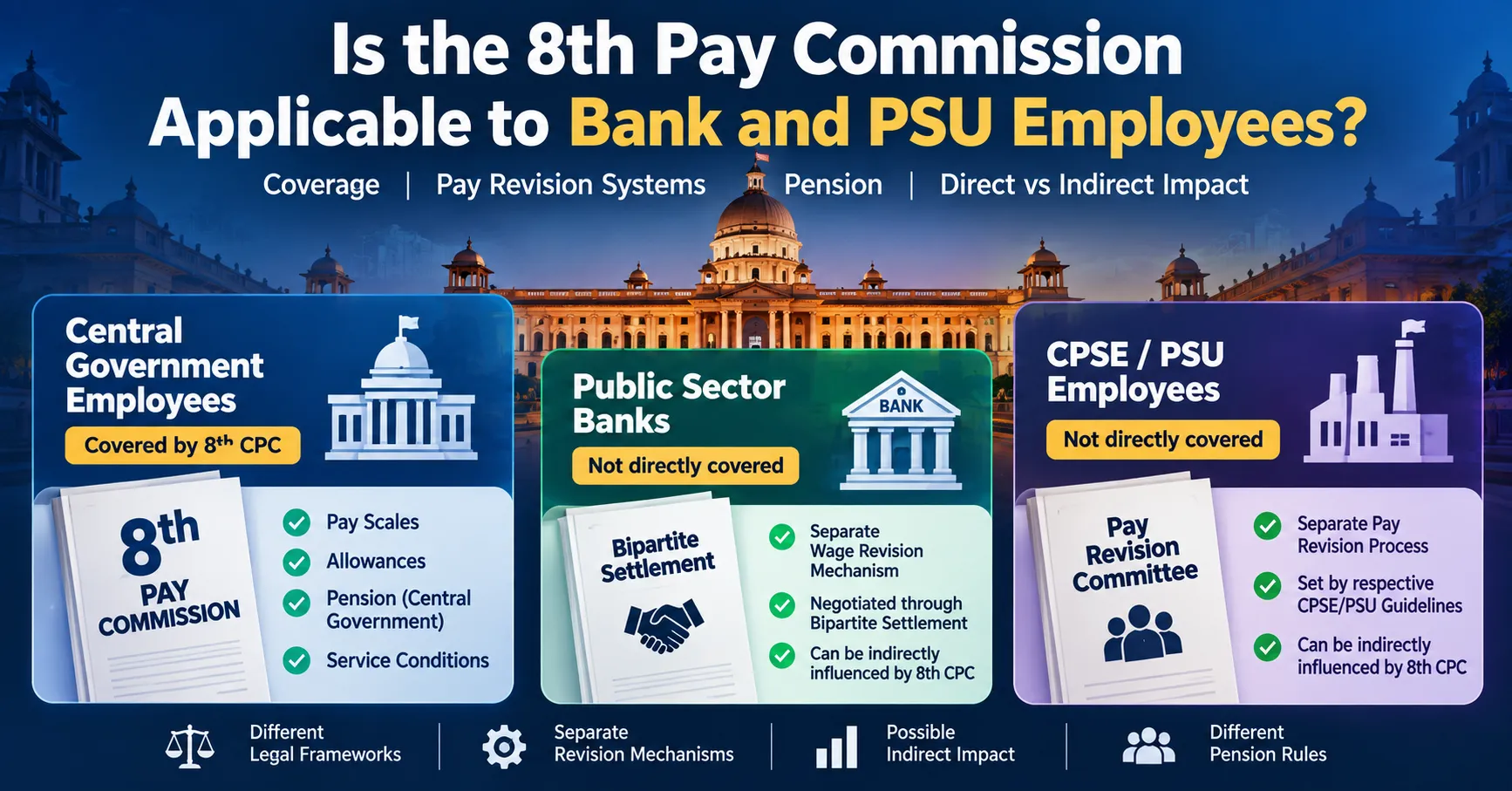
That is where the confusion usually starts. The 8th Central Pay Commission does not directly decide the salaries of public sector bank employees or Central Public Sector Enterprise (CPSE/PSU) staff. Pay Commissions are set up strictly for Central Government civil servants, defence forces, and sovereign ministry staff—people whose salaries are drawn straight from the Consolidated Fund of India.
Bank employees get their pay revised through negotiated Bipartite Settlements. PSU employees follow Pay Revision Committees and separate enterprise-level wage talks. That does not mean the sectors are completely disconnected, though. When the 8th CPC raises civil service pay, it creates benchmark numbers that bank and PSU unions use during their own negotiations later on.
1. What the 8th Pay Commission Actually Covers
What the official terms say, and who the Commission is legally authorized to review.
The Union Cabinet formally approved the Terms of Reference for the 8th Central Pay Commission on 28 October 2025. Shortly after, on 3 November 2025, the government issued an official Gazette notification constituting the Commission under Justice Ranjana Prakash Desai.
Official press releases from the Cabinet make the boundary very clear. The Commission has one job: examine and recommend changes to the pay, allowances, and retirement benefits of Central Government personnel. This covers people working directly in sovereign ministries, central civil services, defence forces, and departments like Posts and Railways.
Why PSUs Are Mentioned in Clause (v) (And Why It Trips People Up)
If you look at the official Terms of Reference, you will notice public sector enterprises mentioned in Clause (v). It asks the Commission to "keep in view the prevailing emolument structure, benefits, and working conditions available to employees of Central Public Sector Undertakings and the private sector."
Seeing that line causes many people to assume PSU employees are covered. But read it carefully. The government is telling the Commission to study PSU and private company salaries as a yardstick. The idea is to make sure civil service salaries stay competitive enough to attract good people. It does not give the Commission any legal authority to set or change PSU pay.
Direct Pay Commission Scope vs. Separate Wage Systems
How different groups in public employment get their pay decided.
2. Why Government Ownership Does Not Mean Civil Service Employment
The difference between working for the state and working for a company the state owns.
Who Signs Your Paycheck?
Most people use "government employee" and "PSU employee" as if they are the same thing. In the eyes of Indian law, they are completely different:
-
•
Central Government Civil Servants: Hold civil posts directly under the sovereign government. Their jobs are protected under Article 311 of the Constitution, and their pay comes directly from the government treasury (the Consolidated Fund of India).
-
•
Bank and PSU Employees: Work for independent corporate bodies established under specific parliamentary acts or the Companies Act. Even if the President of India owns most of the shares, your legal employer is the company's corporate board, not the government itself.
The Supreme Court Ruling in A.K. Bindal (2003)
This principle was tested in 2003 in A.K. Bindal v. Union of India. Employees of struggling public sector companies argued that because the government owned the business, the government had to step in and give them pay parity with Central Government workers.
The Supreme Court made three simple points:
1. Companies are separate entities: A government company is an independent legal entity distinct from the Union Government.
2. Not civil servants: PSU employees do not hold civil posts and do not get constitutional civil-servant protections.
3. Pay depends on company health: Commercial companies must fund their own wage increases. The government cannot be forced to pay corporate salaries from the national budget.
3. How Public Sector Bank Salaries Are Actually Decided
How commercial bank salaries are negotiated, and where SBI and RRBs fit into the picture.
Bank employees do not wait for a Pay Commission. Their salaries are revised through an industry-wide collective bargaining system governed by the Industrial Disputes Act. Roughly every five years, two sides sit down to negotiate:
Represents the management of public sector banks and several older private sector banks during industry-wide negotiations.
An umbrella body representing multiple recognized bank employee unions and officer associations across the country.
Clerks vs. Officers: Bipartite Settlements and Joint Notes
The agreement is divided into two parts. For clerical and subordinate staff, the deal is signed as a Bipartite Settlement (BPS). For officers (Scale I to VII), a matching agreement called a Joint Note is signed at the same time between officer associations and the IBA.
Bank employees are currently governed by the 12th Bipartite Settlement and 9th Joint Note, which were signed on 8 March 2024:
- Term of the Agreement: Covers five years from 1 November 2022 to 31 October 2027.
- The Pay Hike: Granted a 17% increase on the annual wage bill and merged dearness allowance points.
- Next Routine Revision: The next regular bank wage round will be the 13th Bipartite Settlement, which falls due only from 1 November 2027.
State Bank of India (SBI)
SBI operates under its own law, the State Bank of India Act, 1955. SBI management sits at the IBA negotiating table. Once the industry settlement is signed, the SBI Central Board formally adopts the revised terms through internal circulars. SBI staff do not follow the Central Pay Commission.
Regional Rural Banks (RRBs)
Section 17 of the RRB Act says the Central Government sets RRB pay. Under the landmark National Industrial Tribunal (NIT) Award of 1990, RRB staff have a legally recognized right to pay parity with sponsor commercial banks. When a new Bipartite Settlement is signed, the Department of Financial Services (DFS) issues circulars passing those same pay scales along to RRB staff.
How a Bank Wage Settlement Works
4. CPSE and PSU Employees: The Pay Revision Committee (PRC)
How Central Public Sector Enterprises handle executive pay and worker wage talks.
People often use the word "PSU" as a catch-all. In official administration, commercial enterprises like ONGC, NTPC, IOCL, and SAIL are called Central Public Sector Enterprises (CPSEs). They are regulated by the Department of Public Enterprises (DPE) under the Ministry of Finance. They do not follow the Central Pay Commission.
Executive pay is reviewed every ten years by a specialized Pay Revision Committee (PRC) appointed by the Union Government. The PRC recommends pay scales for board members, executives, and non-unionized supervisory staff.
For non-executive employees and unionized factory workers, there is no centralized Pay Revision Committee. Instead, each individual CPSE management negotiates directly with its recognized local unions.
The Affordability Rule: Why Profits Dictate Pay Hikes
This is where CPSE pay revision differs most from the Central Government budget:
- A CPSE can only roll out higher pay scales if it can afford the entire extra cost from its own profits.
- The government does not provide budget support to pay for PSU wage hikes.
- If a CPSE is loss-making or runs on thin margins that cannot absorb the increase, it is barred from rolling out the revised pay scales until its finances recover.
- A significant part of executive pay comes as Performance Related Pay (PRP). This variable bonus rises or falls each year depending on how well the company meets its targets under its annual Memorandum of Understanding (MOU) with the government.
5. Insurance Companies, Regulators, and Autonomous Bodies
How pay gets revised across other specialized government institutions.
Public Sector Insurance
Salaries in LIC are governed under Section 48 of the Life Insurance Corporation Act, 1956. General insurance companies follow similar government-approved frameworks.
Management and employee unions hold bilateral discussions. Once agreed upon, the terms are approved by the Department of Financial Services (DFS) and issued as official Gazette notifications.
Regulators (RBI, SEBI, NABARD)
Statutory financial regulators operate under their own independent service regulations approved by their governing boards.
Their salary revisions are decided internally and sent to the Ministry of Finance for approval, completely outside the Central Pay Commission process.
Central Autonomous Bodies (CABs)
Organisations like central universities and autonomous research institutes often follow Central Pay Commission pay scales, but this does not happen automatically.
New pay scales apply to autonomous bodies only after the Department of Expenditure issues a specific adoption order approving the change.
6. Pensioners and Retirees: Why Bank and PSU Retirees Miss Out on CPC Hikes
Why pay commission pension increases do not automatically reach retired bank and PSU workers.
This is one of the most common points of confusion for retirees. Many ask: "If the 8th Pay Commission updates government pensions, won't it update mine too?" The answer depends on where you retired from:
Central Government Pensioners
- How It Is Funded: Paid straight out of tax revenues through the Consolidated Fund of India.
- How It Is Revised: Pay Commissions recommend a fitment factor that recalculates basic pension.
- The Pension Plan: Traditional Old Pension Scheme (OPS) or the Unified Pension Scheme (UPS) introduced from 1 April 2025 (assuring a 50% basic pension for 25 years of service).
- 8th CPC Connection: Directly covered from the notional date of 1 January 2026.
Public Sector Bank Pensioners
- How It Is Funded: Paid out of independent bank pension funds, not the government treasury.
- Governing Rules: Governed by the Bank Employees' Pension Regulations, 1995.
- Basic Pension Reality: Basic pensions stay frozen at the pay level when the employee retired. While Dearness Relief adjusts for inflation, basic pension updation has not been approved.
- Recent Changes: The 12th BPS (March 2024) introduced monthly ex-gratia payments for older retirees, but left the underlying basic pension unchanged.
CPSE / PSU Retirees
- How It Is Funded: Paid from defined-contribution superannuation trust funds managed by each enterprise.
- Governing Rules: Follows DPE superannuation guidelines (capped within a 30% ceiling on company contributions for PF, Gratuity, PRMB, and Pension).
- How It Is Calculated: Monthly annuity payouts depend on how much accumulated in the employee's retirement fund, not on a government-defined formula.
- 8th CPC Connection: Entirely separate. Pay Commission recommendations do not apply here.
What does "pension updation" actually mean? It means recalculating an older pensioner's basic pension using the newer, higher pay scales that active staff receive. Bank retirees have argued for decades that their 1995 Pension Regulations intended for pensions to be updated with every Bipartite Settlement, just like Central Government pensions update with every Pay Commission.
The Government and the IBA have resisted this demand, pointing out that bank pension funds face large funding shortfalls and that the 1995 rules contain no statutory requirement for automatic updates. This dispute led to major litigation in the Supreme Court under M.C. Singla v. Union of India. As of September 2026, the case is still before the court, and no binding order mandating parity has been issued.
7. Looking at Past Cycles: Different Clocks, Separate Systems
Why the calendar proves that banks, PSUs, and the civil service run on separate schedules.
If banks, PSUs, and the Central Government shared a single wage system, their pay increases would take effect on the exact same dates. Looking back over the last twenty years shows they operate on completely independent schedules. When their dates land near one another, it is because general economic pressures—like inflation—push all employers to adjust wages around the same time.
| Revision Cycle | Central Government (CPC) | Public Sector Banks (BPS) | CPSE Executives (PRC) |
|---|---|---|---|
| Mid-2000s Cycle | 6th CPC: From 1 Jan 2006 | 9th BPS: From 1 Nov 2007 | 2nd PRC: From 1 Jan 2007 |
| Mid-2010s Cycle | 7th CPC: From 1 Jan 2016 |
10th BPS: Nov 2012 – Oct 2017 11th BPS: Nov 2017 – Oct 2022 |
3rd PRC: From 1 Jan 2017 |
| Mid-2020s Cycle | 8th CPC: Expected w.e.f. 1 Jan 2026 | 12th BPS: 1 Nov 2022 – 31 Oct 2027 | 4th PRC: Targeted w.e.f. 1 Jan 2027 |
When the 7th CPC took effect on 1 January 2016, public sector bank employees were in the middle of their 10th Bipartite Settlement (2012–2017). They did not get an automatic raise from the 7th CPC. The same thing is happening now. The 8th CPC has an expected notional date of January 2026, right in the middle of the active 12th BPS, which remains in force until late 2027.
8. Direct vs. Indirect Impact: The Ripple Effect
There is a difference between a legal right and a market ripple. Here is how the 8th CPC still matters.
The 8th Pay Commission has zero legal power over banks or PSUs. But in the real world, the Central Government is the largest formal employer in the country. When it raises salaries, the ripple effects spread across the entire public sector:
4th PRC Baseline
When the 4th PRC sits down to design pay scales for CPSE executives for 2027, it will look closely at the 8th CPC minimum pay and fitment factors to make sure PSU packages stay competitive.
13th BPS Demands
When bank unions draft their demands for the 13th BPS in late 2027, the 8th CPC numbers will be their main talking point to argue that bank employees should not fall behind civil servants.
Recruitment Pressure
Banks, PSUs, and the civil service recruit from the exact same pool of graduates through exams like UPSC, IBPS, and GATE. If civil service salaries pull ahead, banks and PSUs face immediate pressure to keep starting pay attractive.
UPS Pension Demands
When the Central Government introduced the Unified Pension Scheme (UPS) in 2025, bank and PSU unions immediately demanded similar guaranteed benefits. Government decisions always set the standard for employee expectations.
Comparing Starting Monthly Basic Pay Across Sectors
Includes EstimatesHow current starting basic salaries compare across banks, PSUs, and government roles.
9. Where Things Stand Right Now (September 26, 2026)
A quick snapshot of ongoing developments, active agreements, and pending matters.
8th CPC Progress
Consultations OngoingThe 8th Pay Commission is currently in its consultation phase. The deadline for receiving memorandums from employee associations ended in May 2026, and the Commission is conducting regional tours, including visits to Chandigarh and Mumbai.
Timeline: Final recommendations are expected around mid-2027.
Effective Date: 1 January 2026 serves as the expected reference date for calculating back-pay, not the date when people actually receive money.
Banking Sector Status
12th BPS ActivePublic sector banks are currently operating under the 12th Bipartite Settlement and 9th Joint Note signed in March 2024. Revised salaries and monthly ex-gratia payments to eligible retirees are being paid normally.
Next Revision: The 13th BPS falls due from 1 November 2027.
Court Update: The M.C. Singla pension updation case remains before the Supreme Court without a final verdict as of September 2026.
CPSE Sector Status
Awaiting 4th PRCWith the 10-year term of the 3rd PRC ending in late 2026, oil PSU officer associations and other executive groups have formally asked the DPE to set up the 4th Pay Revision Committee.
Target Date: Targeted to take effect from 1 January 2027.
Condition: Even after recommendations are approved, pay increases will still depend on whether each company can afford them.
The Pension Picture
UPS ActiveThe Unified Pension Scheme (UPS) was rolled out on 1 April 2025 for eligible Central Government employees, with more than 1.22 lakh staff opting into the framework by late 2025.
No Extension: Neither the finance ministry nor the DPE has issued any orders extending the UPS to bank or CPSE staff.
10. Master Comparison Matrix
How salary and pension rules differ across the public sector.
| Feature | Central Government | Public Sector Banks | CPSEs / PSUs | Insurance / Statutory |
|---|---|---|---|---|
| Directly Covered by 8th CPC? | YES | NO | NO | NO |
| Who Is the Employer? | Union of India (President) | Bank Corporate Board | CPSE Corporate Board | Statutory Corporation Board |
| How Pay Is Decided | Central Pay Commission | IBA & Union Negotiations | Pay Revision Committee (PRC) | DFS / Corporation Boards |
| Legal Agreement Type | Cabinet & Gazette Orders | Bipartite Settlement & Joint Note | PRC for execs; Plant talks for staff | Gazette orders under enabling acts |
| How Often Pay Is Revised | Every 10 Years | Every 5 Years | Every 10 Years | Roughly every 5 Years |
| Current Agreement | 7th CPC in force; 8th formed | 12th BPS (Nov 2022 – Oct 2027) | 3rd PRC (in force since 2017) | Gazette rules under LIC/GIC Acts |
| Next Revision Due | 8th CPC (1 Jan 2026 notional) | 13th BPS (from 1 Nov 2027) | 4th PRC (targeted 1 Jan 2027) | Next bilateral talks round |
| Where the Money Comes From | Consolidated Fund of India | Bank Operating Earnings | Company Revenues & Profits | Premium and Fee Earnings |
| Pension Scheme Type | OPS / UPS (April 2025) | 1995 Pension Regulations / Trusts | Superannuation Fund Trusts | Statutory Rules (e.g. LIC 1995) |
11. Sorting Fact from Fiction
Clearing up five widespread misconceptions about pay revisions.
"If the government owns it, everyone working there is a government employee."
Fact: Owning shares in a company does not make its workers civil servants. The Supreme Court made this clear in A.K. Bindal (2003). Government companies are separate legal entities, and their staff do not get Article 311 protections or Pay Commission coverage.
"January 1, 2026 means 8th CPC salaries are already finalized and being paid."
Fact: That date is simply the reference date from which back-pay will be calculated once the report is finalized. The Commission is still holding consultations. Final recommendations are expected around mid-2027, followed by Cabinet review and actual implementation.
"Bank workers will get a pay bump the moment the 8th CPC report lands."
Fact: Bank salaries are locked under the 12th Bipartite Settlement until 31 October 2027. Any new salary structure will have to be negotiated independently under the 13th Bipartite Settlement between the IBA and bank unions.
"Loss-making PSUs get Pay Commission wage hikes anyway."
Fact: Unlike the Central Government, which funds salaries from tax collections, CPSEs must fund their pay hikes entirely from internal profits. Under DPE rules, if a company is losing money, it is legally barred from implementing new pay scales.
"Bank pensioners will automatically get the 8th CPC pension multiplier."
Fact: Bank pensions are paid from separate bank-run pension trusts under the 1995 Pension Regulations. They do not get money from the state treasury. Updating bank pensions requires a bilateral agreement with the IBA or a specific order from the Supreme Court.
12. Frequently Asked Questions
Direct answers to the questions readers ask most often.
📖 Also Read
Official Sources and Court Decisions
The details in this guide are based on official government orders, circulars, and judicial records as of 26 September 2026:
The Bottom Line
It is easy to see why people assume government ownership means Pay Commission benefits. But the law draws a clear line between working for the sovereign state and working for a commercial entity the state owns. The 8th Pay Commission belongs to Central Government employees. Bank and PSU staff have their own negotiation tables and committee cycles. While you won't see an automatic 8th CPC increase on your payslip, the standards it sets will certainly echo in your next round of wage talks.