
Every few weeks, a fresh batch of 8th Pay Commission dates does the rounds on WhatsApp groups and employee forums. One post says the fitment factor is locked at 2.86. Another claims arrears will start hitting bank accounts from January. A third insists implementation has already been “confirmed” for a specific month. Most of this traces back to nothing official at all.
If you’re a central government employee or pensioner trying to plan around the 8th Pay Commission, the real challenge isn’t finding information. It’s telling which piece of information actually means something. Some dates are backed by a Gazette notification or a Cabinet decision.
Others are guesses dressed up as facts, repeated so often they start to sound true. This article works through the genuine 8th Pay Commission key dates. What has actually happened, what’s still pending, and what to watch for as the process inches toward implementation.
Overview of the 8th Pay Commission
A Central Pay Commission is a panel the Government of India sets up roughly once every ten years, under the Department of Expenditure, to review how central government employees, pensioners, and defence personnel are paid. It examines basic pay, allowances, retirement benefits, and service conditions, then hands the government a set of recommendations.
The 8th Central Pay Commission’s decisions will touch close to 50 lakh serving employees and somewhere between 65 and 69 lakh pensioners and family pensioners, across civilian departments and the armed forces. That’s a lot of households waiting on an answer.
Right now, the Commission is somewhere in the middle of its work. It has a Chairperson, two other members, a formal Terms of Reference, and a working secretariat. It has finished collecting public feedback and written submissions from employee unions. What it does not have is a final report, a Cabinet decision, or a confirmed fitment factor. Anyone telling you otherwise is either speculating or repeating someone else’s speculation.
That distinction, official milestone versus confident guess, is what this article keeps coming back to. A Gazette notification changes the legal status of the process. A prediction, however specific it sounds, does not.
Key Dates in the 8th Pay Commission Timeline
The table below lists the confirmed milestones completed so far, along with the projected stages still ahead. Where a date is expected rather than confirmed, it’s labelled that way.
| Date / Period | Event | Status | Why It Matters |
|---|---|---|---|
| 16 Jan 2025 | Preliminary government announcement | Officially announced | Signalled the start of the 10-year revision cycle after the 7th CPC |
| 28 Oct 2025 | Union Cabinet approves Terms of Reference | Confirmed | Set the Commission’s scope and mandate |
| 3 Nov 2025 | Gazette Notification formally constitutes the Commission | Confirmed | Appointed the Chairperson and members, notified the Terms of Reference |
| 5 Feb – 31 Mar 2026 | Public questionnaire window (MyGov) | Confirmed, completed | Collected public feedback on inflation, wages, and allowances |
| 5 Mar – 15 Jun 2026 | Union memorandum submission window | Confirmed, completed | Federations formally submitted their demands |
| Closed 30 Jun 2026 | Cadre and expenditure data deadline for ministries | Confirmed, completed | Gave the Commission the raw data for its fiscal modelling |
| May – Oct 2026 | Regional stakeholder hearings | Confirmed, ongoing | Recorded oral submissions from federations across zones |
| Under review | Decision on ToR Para 2(e), pre-2026 pension parity | Pending | Will determine how past retirees are treated |
| By May 2027 | Final report submitted to the Finance Minister | Statutory deadline | Ends the Commission’s independent work |
| Mid-to-late 2027 (projected) | Empowered Committee of Secretaries review | Expected | Checks feasibility and cost before Cabinet sees it |
| Late 2027 / early 2028 (projected) | Union Cabinet approval | Expected | The actual decision on pay, fitment, and pensions |
| 1–2 months post-Cabinet (projected) | Notification of Revised Pay Rules | Expected | Publishes the legal pay matrix and fitment multiplier |
| Targeted 1 Jan 2026 (unconfirmed) | Effective date of the new pay structure | Expected, not finalised | Decides how far back arrears will be calculated |

A word on how to read this table: “confirmed” means a Gazette notification, Cabinet decision, or official government statement exists. “Expected” or “projected” means it’s a reasonable estimate based on the Commission’s own deadlines, not something the government has announced.
The Commission’s formal constitution
The real starting gun was 3 November 2025, when the Ministry of Finance published Resolution No. 1/1/2025-E-III(A) in the Gazette of India. This is the notification that gave the 8th CPC its legal existence, and it named three people to run it: Justice Ranjana Prakash Desai, a former Supreme Court judge, as Chairperson; Prof. Pulak Ghosh of IIM Bangalore, who also sits on the Economic Advisory Council to the Prime Minister, as part-time Member; and Pankaj Jain, a former central government Secretary, as Member-Secretary.
Paragraph 5 of that same resolution set an 18-month clock running. The Commission has until roughly May 2027 to submit its recommendations. That single line is arguably the most important sentence in the entire timeline, because everything downstream (the Cabinet decision, the notification, the eventual salary revision) depends on when this report actually lands.
Three consultation windows, all now closed
Through the first half of 2026, the Commission ran three separate channels for gathering input. A public feedback window on MyGov, open from 5 February to 31 March, took general comments on inflation and cost of living. A formal memorandum window, open until 15 June, is where recognised unions such as the NC-JCM, AIDEF, and the Bharat Pensioners’ Samaj filed their actual demands on fitment and pensions. And a data portal for ministries, which closed on 30 June, collected the cadre strength and spending figures the Commission needs for its own calculations.
All three are done. What happens with that information, how it gets weighed against the government’s fiscal room, is happening inside the Commission right now, mostly out of public view.
Regional hearings and the pension dispute nobody expected
Between May and October 2026, Commission members travelled to different zones to hear from local cadre federations directly. Chennai on 7–8 September, Puducherry the next day, Chandigarh from 16–18 September, Bengaluru on 7–8 October.
One issue surfaced repeatedly at these hearings: pensioner bodies noticed that the Terms of Reference for this Commission are worded differently from the 5th, 6th, and 7th CPCs on the question of past pensions. Where earlier commissions explicitly mandated revising pensions already in payment, this ToR talks about reviewing pensions outside the National Pension System while accounting for the “unfunded cost” of non-contributory schemes. Groups like the Retired Employees Welfare Association read that as a possible gap for anyone who retired before 1 January 2026.
In August 2026, the Department of Personnel & Training passed these concerns on to the Department of Expenditure for a decision. As of now, no clarification has been issued. This is worth watching closely if you’re already retired or about to be. It’s genuinely unresolved, not just union noise.
Why the May 2027 deadline matters more than any other date
There’s a lot of chatter about the Commission submitting early, or the government fast-tracking things. In a written Rajya Sabha reply on 28 July 2026, Minister of State for Finance Pankaj Chaudhary put that to rest: no interim report has been submitted, and the Commission is under no obligation to update the government on its internal deliberations before the 18-month mark. May 2027 stands as the target.
After the report lands, it doesn’t go straight to the Cabinet. It goes to an Empowered Committee of Secretaries, usually chaired by the Cabinet Secretary, with members from Finance, DoPT, Defence, and Railways. Their job is to check what’s financially and administratively workable before anything reaches political decision-makers. Only after that review is a Cabinet Note drafted, and only after Cabinet approval does the Department of Expenditure notify the actual Central Civil Services (Revised Pay) Rules, the document with the real pay matrix in it.
That’s three separate stages after the report is submitted, each with its own timeline. It’s why credible estimates put the earliest Cabinet decision in late 2027 or early 2028, not sooner.
Expected Changes and Developments
The fitment factor: still nothing official
The fitment factor is the multiplier applied to your current basic pay to get the new one. Numbers like 1.82, 2.86, and even 3.68 have been floating around for months, along with minimum basic pay claims of ₹34,500, ₹44,000, or ₹68,000.

None of this comes from the government. Chaudhary told Parliament during the Monsoon Session in July and August 2026 that no fitment factor or minimum pay figure has been considered or fixed. The ₹68,000 figure, for instance, traces back to a memorandum from postal and defence federations, built on their own reading of the 15th Indian Labour Conference norms adjusted for inflation. It’s a demand, not a decision. The Commission will arrive at its own number using wage-erosion data, the Aykroyd formula for basic family needs, and the government’s actual budget capacity. None of that becomes real until it’s in the final report and cleared by Cabinet.
DA merger: not on the table right now
Some federations, including the NC-JCM, have asked for Dearness Allowance to be merged into basic pay once it crosses a certain threshold, arguing it prevents real income from stagnating between Commissions. The government has already answered this one in Parliament: there is no proposal currently under review to merge DA with basic pay ahead of the Commission’s report. The 7th CPC dropped this practice in favour of a pay matrix with its own built-in adjustments, and nothing so far suggests the 8th CPC will behave differently before its final recommendations are out.
Pensions, and where the Unified Pension Scheme fits in
Retirement benefits are more layered this time because the Unified Pension Scheme now sits alongside the older National Pension System and Old Pension Scheme. A few things are actively under discussion: how pre-2026 and post-2026 retirees are treated relative to each other, a push from pensioner federations to cut the commutation recovery period from 15 years to 12, and proposals for earlier age-based pension increases (at 65, 70, and 75) instead of waiting until 80. None of these have moved past the proposal stage.
Effective date and arrears: the part most people get confused about
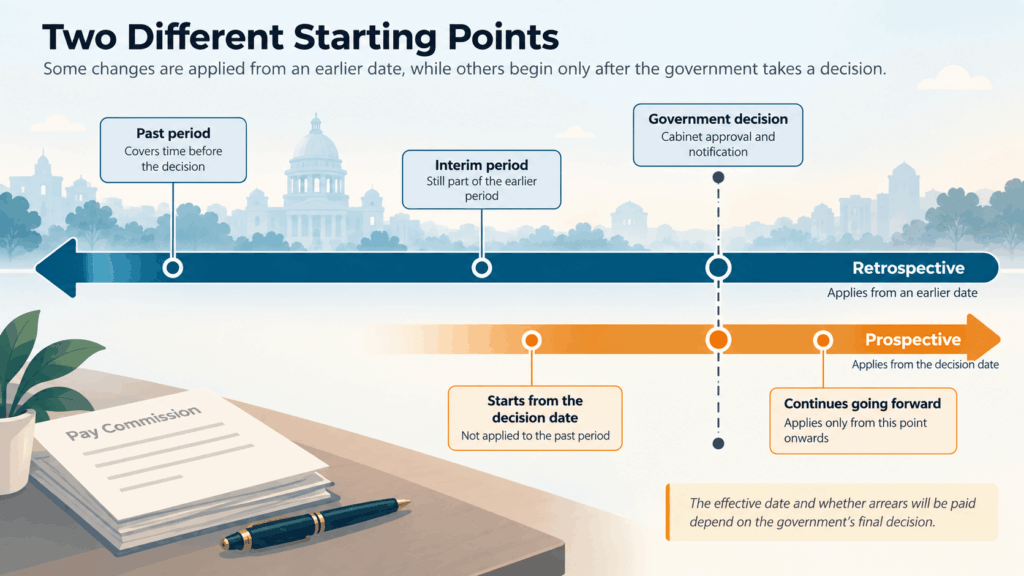
This is worth separating clearly, because a lot of the confusion online comes from mixing up two different things: when the new pay structure applies from, and when it actually shows up in your bank account.
Since the 7th CPC took effect on 1 January 2016, the ten-year cycle points to 1 January 2026 as the nominal effective date for the 8th CPC. But that date isn’t written into the Terms of Reference as a guarantee. Given the May 2027 report deadline, the Cabinet decision and formal notification are realistically closer to late 2027 or early 2028.
If the Cabinet does set the effective date retrospectively to January 2026, employees would be owed arrears on basic pay and pensions for the gap in between. Allowances work differently: HRA, transport allowance, and other compensatory allowances are historically applied only from the date of the actual notification, not retrospectively. If you want the mechanics of how that arrears calculation typically works, our detailed explainer on salary arrears and the effective date walks through it separately. HRA specifically depends on your city’s classification, which we’ve also covered in this breakdown of the X/Y/Z city categories.
Defence personnel and pensioners have their own set of considerations layered on top of the general timeline, particularly around cadre-specific allowances. We go into that separately in our explainer on the 8th CPC and defence pay issues.
How to Prepare for Upcoming Changes
You can’t speed any of this up, but there’s genuine groundwork worth doing while it plays out.

- Check your service book. Confirm your increments, promotions, and cadre transfers are all correctly signed off by your DDO. Errors here get expensive later.
- Verify your current pay level. Match your basic pay against the 7th CPC matrix on your payslip. It sounds basic, but mismatches happen more often than you’d think.
- Keep pension paperwork current. If you’re a pensioner or close to retirement, make sure your bank account details, Dearness Relief entries, and family pension nominations are updated on Bhavishya or SPARSH.
- Don’t confuse pay revision with MACP. A Pay Commission revision shifts the whole matrix upward for everyone. Career progression under MACP, at 10, 20, and 30 years of service, is a separate track and keeps running exactly as it does now until the Commission says otherwise.
- Hold off on big financial decisions. Taking on a larger home loan because a viral post claims a 2.86 fitment factor is a real risk. Base your planning on your current confirmed salary, not a number from a forum.
- Use official sources, not forwarded messages. The 8th CPC’s own portal carries notices and official communications directly. The Department of Expenditure and the Press Information Bureau publish Cabinet decisions when they happen, and Parliament’s own question records confirm ministerial statements word for word.
If you’d like to see how a change in fitment factor or pay level would actually play out for your own salary once real numbers exist, our 8th Pay Commission salary calculator is built for exactly that.
Frequently Asked Questions
The confirmed dates are the preliminary announcement in January 2025, Cabinet approval of the Terms of Reference on 28 October 2025, and formal constitution through the Gazette notification on 3 November 2025. Through 2026, the public feedback window closed 31 March, the memorandum window closed 15 June, and ministry data submissions closed 30 June. The next confirmed deadline is the final report, due by May 2027.
There’s no confirmed implementation date. Given the May 2027 report deadline, followed by an Empowered Committee of Secretaries review and Cabinet approval, realistic estimates point to late 2027 or early 2028 for a formal decision.
No. The Finance Ministry told Parliament in July and August 2026 that no fitment factor or minimum salary figure has been fixed or even formally proposed by the government. Numbers circulating online are union demands or independent calculations, not policy.
In the near term, it’s the Department of Expenditure’s decision on the pension parity question raised under Terms of Reference Para 2(e). Beyond that, the big one is the formal submission of the Commission’s report, due by May 2027.
The Commission has an 18-month statutory window from its constitution, which puts the deadline at roughly May 2027. No interim report has been submitted as of the Commission’s most recent status update to Parliament.
That depends entirely on what effective date the Cabinet eventually sets. If it follows precedent and applies the revision retrospectively to January 2026, arrears would be calculated on basic pay and pensions for the intervening period. Allowances typically aren’t backdated the same way.
The 8th CPC secretariat portal, the Department of Expenditure’s website, Press Information Bureau releases, and Parliament’s own question archives are the most reliable places to confirm anything you read elsewhere.
Research Note
The most solid confirmed milestone is the 3 November 2025 Gazette constitution of the Commission, which named the Chairperson and members and started the 18-month reporting clock. The next real trigger to track is the Department of Expenditure’s pending decision on Para 2(e) pension parity, followed by the report submission itself, due by May 2027.
The biggest open question is whether the Commission will need an extension past that deadline, and how long the Empowered Committee of Secretaries will take once it has the report. Everything tied to a specific fitment factor, minimum pay figure, or a 1 January 2026 implementation date is an expectation or a union demand, not a confirmed government position.
Leave a Reply