
Every couple of months, a message does the rounds claiming the 8th Pay Commission is about to double house rent allowance, or that some fast-growing city is being bumped up a tier. Neither is true. Not yet, anyway. What’s actually happening with HRA right now is a lot less dramatic than the forwards suggest, and it’s worth understanding properly if you’re a central government employee trying to plan your household budget.
How the current rates got here
HRA is the monthly top-up the government pays on top of basic salary to help cover rent. Right now, 30% of basic pay in the biggest cities, 20% in mid-sized ones, and 10% everywhere else feel like the “normal” numbers. They’re not where things started.
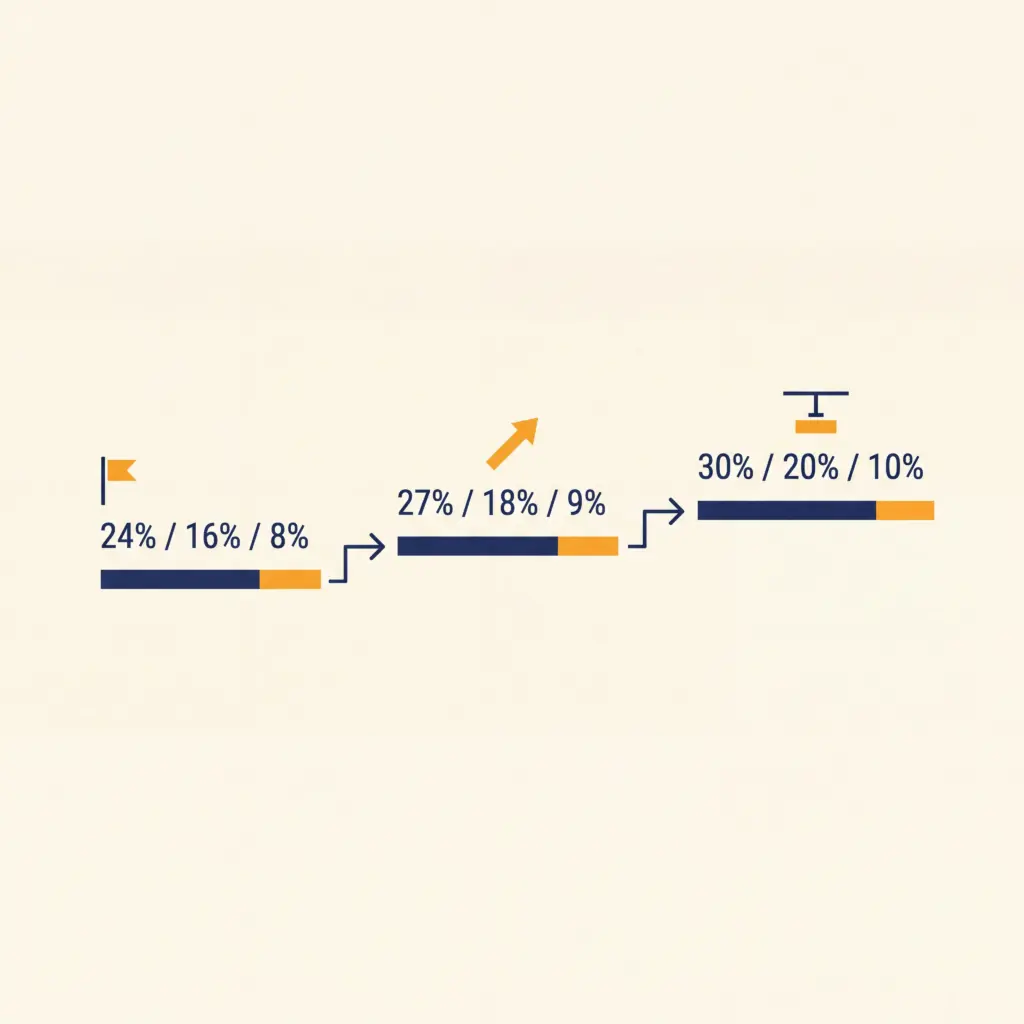
When the 7th Pay Commission rolled out in 2017, HRA actually opened lower, at 24%, 16%, and 8%. Basic salaries had just jumped by a wide margin under the new pay structure, so the government dialed the percentages back to keep the total payout from spiraling.
Then a built-in escalator kicked in, tied to Dearness Allowance, the periodic cost-of-living top-up that rises as inflation does. Cross 25% DA, and HRA moved up a notch, to 27/18/9. Cross 50% DA, which happened at the start of 2024, and HRA hit its ceiling: 30/20/10, where it still sits today.
So the numbers everyone thinks of as “the HRA rate” are really the maxed-out version of a formula written back in 2017. There’s also a floor built in, a guaranteed minimum monthly amount, ₹5,400, ₹3,600, or ₹1,800 depending on the tier, for junior staff whose basic pay is too low for the percentage alone to add up to much.
How a city ends up in X, Y, or Z
The whole system runs on population, and specifically population from the 2011 Census. A city needs 50 lakh people or more to count as Class X. Between 5 lakh and 50 lakh gets you Class Y. Below that, you default to Class Z, which functions as the catch-all bucket for everywhere else.
A handful of places get treated as exceptions. Towns right next to Delhi, like Noida and Gurgaon, get Class X treatment because of how tightly they’re tied to the capital’s economy, even though their own population wouldn’t qualify on its own. Shillong and Port Blair get bumped to Y through old historical orders, again despite falling short on population.
Here’s the part people mix up constantly: this classification job doesn’t belong to the Pay Commission. It sits with the Department of Expenditure, and the current list still runs on the existing classification order built around 2011 Census numbers. The 2021 Census was postponed, but a new one, Census 2027, has since been officially notified and is now underway, so the population picture won’t stay frozen forever. That said, new Census numbers coming out won’t automatically change anyone’s HRA tier. Any actual revision would still need the Department of Expenditure to issue a fresh order updating the classification list, the same way it did back in 2015.
Where the 8th Pay Commission actually stands
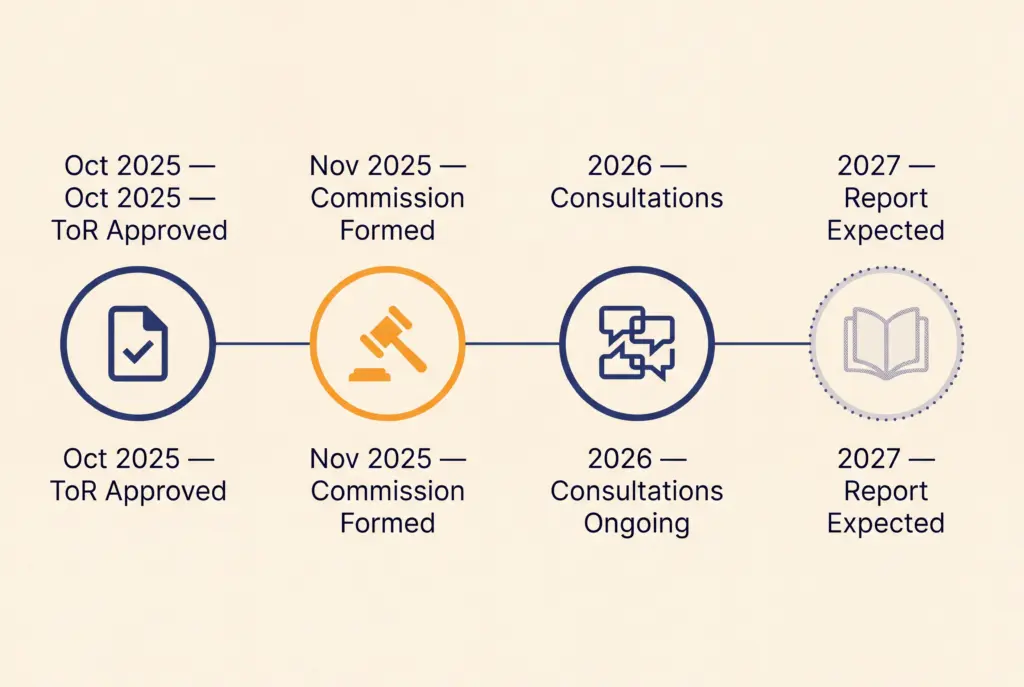
The Cabinet cleared the terms of reference in late October 2025, and the commission was formally set up a few days later under Justice Ranjana Prakash Desai, along with Professor Pulak Ghosh and IAS officer Pankaj Jain. It’s working under an 18-month clock, which points to a final report sometime around mid-2027.
Ministries and employee unions submitted their wishlists through an online portal that closed in mid-2026, and the Commission has since been holding rounds of in-person consultations with stakeholders across the country. As of September 2026, it’s still in that consultation and evidence-gathering stage. No fitment factor has been picked. No new HRA percentages have been officially approved. Anyone claiming the new rate is already locked in is either guessing or repeating a union’s demand as though it were settled policy.
What might change, and why nobody knows yet
History gives a rough template, though not a guarantee. Back in 2016-17, accumulated DA got folded into a new, higher basic pay, and HRA percentages reset downward before climbing back up over time as fresh DA built up. Something similar could happen again.
Employee federations, unsurprisingly, want the opposite: keep the current peak rates, push the minimum basic pay toward ₹69,000, and use a fitment multiplier as high as 3.83. Numbers like 2.28 or 1.92 floating around online are estimates from financial commentators guessing at where things might land between the conservative and union-demanded extremes. None of it is official, and there’s no way to know which figure sticks until the commission actually reports back.
Here’s the part that tends to get lost in the panic: even if the percentage looks smaller on paper, the rupee amount usually goes up anyway, because basic pay itself gets a big bump from the fitment factor. If a ₹50,000 basic pay hypothetically became around ₹1,14,000 under a 2.28x multiplier, then even a lower 24% HRA rate would work out to more take-home money than today’s 20% on the smaller base. None of those figures are official; it’s purely a made-up example to show how the math can play out.
A closer look at Nagaland and the rest of the Northeast
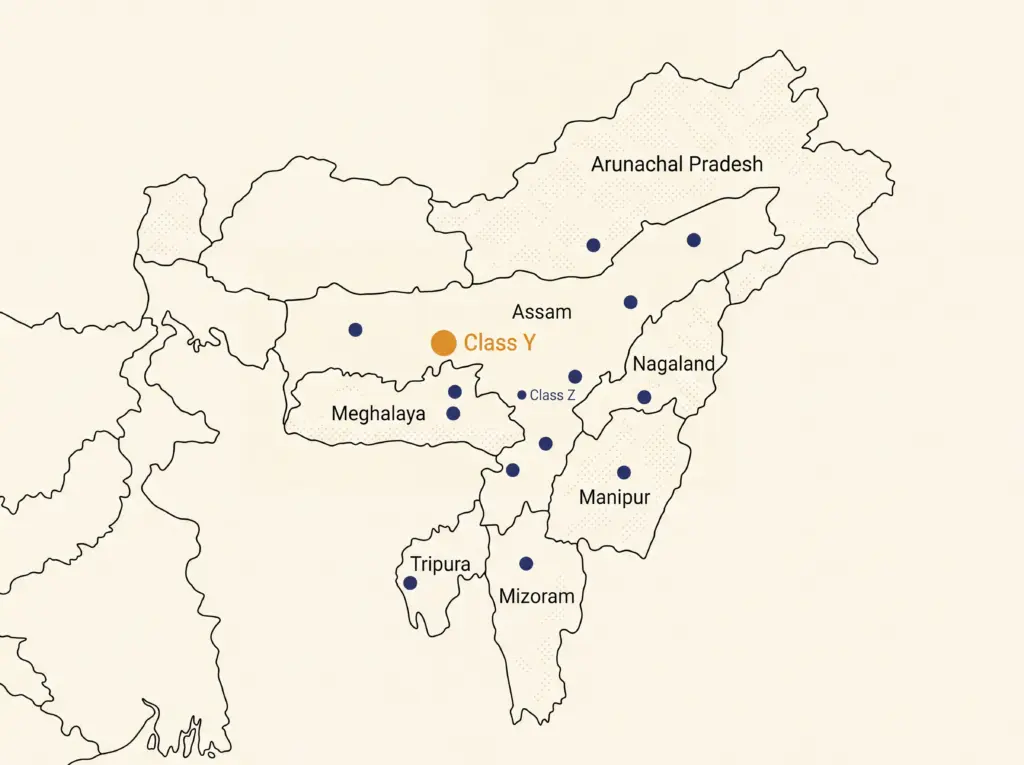
This is where the numbers get personal for a lot of readers. Across the entire Northeast, Guwahati is the only city that meets the population threshold for Class Y under the existing classification order. Shillong also carries Class Y status, though through that separate historical dispensation rather than population. Every other major town, Kohima, Dimapur, Imphal, Agartala, Itanagar, falls under the residual Class Z category by default.
Take Nagaland specifically. Dimapur, the state’s largest commercial hub, had a town population of around 1.2 lakh in the last census, and even counting the entire district, it’s under 3.8 lakh. Kohima, the state capital, comes in smaller still. Neither gets close to the 5 lakh mark Class Y requires. Mokokchung, Wokha, Tuensang, and Zunheboto sit even further below that line. Under the Department of Expenditure’s current 7th CPC framework, the whole state, Dimapur included, is classified as Z for HRA purposes.
That’s not quite the whole story, though. Kohima and Dimapur have their own separate history here: a 1997 office memorandum, later tested through Central Administrative Tribunal and court proceedings, allowed certain Central Government employees posted in those two towns to keep drawing HRA at the higher B/Y-category rate they’d held under earlier pay commissions, rather than dropping to Z when the classification changed. So what an individual employee actually gets can depend on their department, which government orders cover their post, and whether a relevant court ruling applies to their case, not just the state’s default Z tag.
There is some compensation built in. Eligible employees posted to the Northeast, under the conditions set out in the applicable government orders, can draw an additional HRA at their family’s location if their family stays behind elsewhere. There’s also a Special Duty Allowance worth 10% of basic pay, plus a separate Tough Location Allowance for genuinely remote postings. None of it changes the base city classification, but it softens the gap somewhat for those who qualify.
Sorting rumor from reality
A few claims keep resurfacing. The idea that 30/20/10 will simply carry over automatically under the 8th CPC isn’t accurate; those are the current framework’s ceiling rates, and a new commission typically starts with a fresh, lower set of numbers before the DA escalator kicks in again.
Growing cities aren’t about to get promoted just because they’ve expanded on the ground; that still requires the Department of Expenditure to issue an actual order updating the classification list, and while Census 2027 is now underway, its results aren’t out yet. And no, the government hasn’t finalized any fitment factor or HRA figure behind closed doors. What’s out there right now is proposals and speculation, nothing signed off.
Where this leaves you
Until the commission submits its report, the Cabinet signs off, and the finance ministry actually issues the paperwork, today’s 30/20/10 rates keep applying exactly as they are. There’s not much point restructuring your budget around a number someone posted in a forwarded message. Once real figures do land, running them against your own basic pay is a faster way to see what actually changes for you than trying to keep track of whichever percentage happens to be trending that week.
Last updated: September 2026
Leave a Reply