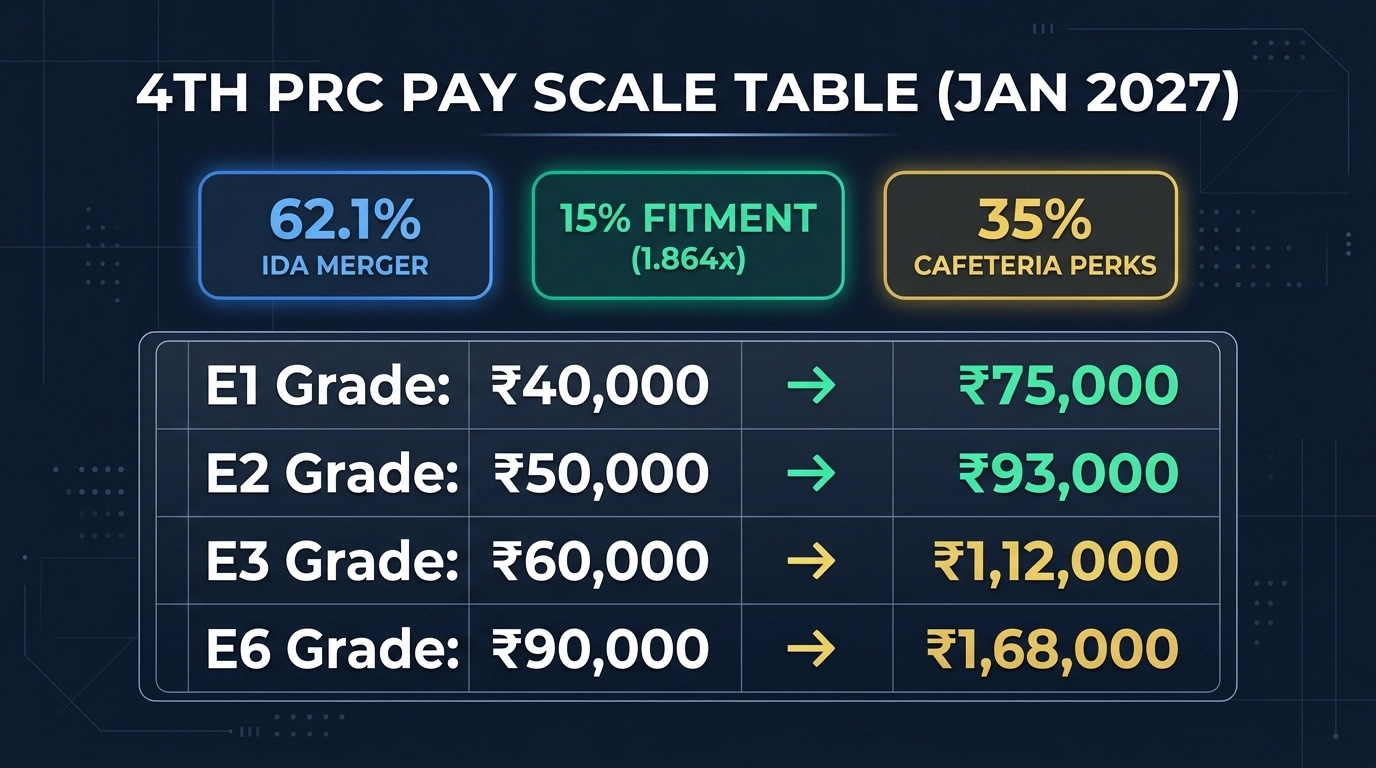
If you work in a central public sector company, you have probably heard colleagues say the January 2027 pay revision will nearly double your salary. On paper, Basic Pay really does jump by about 86%.
Walk into the canteen with that number, though, and someone who lived through the 2017 revision will tell you the catch. Your inflation allowance resets to zero on day one, and your house rent percentage drops at the exact same time. Once income tax and provident fund deductions take their cut, your actual monthly bank credit goes up by a much more realistic 25% to 29%.
Unlike central government staff who use the 8th Pay Commission salary calculator, public sector executives and workmen follow a completely separate set of corporate profit rules (which we broke down in our eligibility guide for bank and PSU employees).
The Full E0 to E9 and Board-Level Pay Scale Table (From Jan 1, 2027)
Every ten years, the Department of Public Enterprises overhauls pay scales for officers in industrial public sector companies. The math happens in two steps. First, whatever inflation allowance (called Industrial Dearness Allowance, or IDA) you are earning on January 1, 2027 gets folded straight into your Basic Pay.
Based on recent inflation data from the Labour Bureau, that January 2027 merger rate is projected to land at 62.1% (you can check the exact monthly inflation math on our January 2027 PSU IDA calculator page).
Second, your company adds a “fitment benefit” on top of that combined total. Think of fitment as your real raise. Depending on how much money your company made over the last three years, the government allows a fitment hike of 5%, 10%, or 15%, while officer unions are pushing hard for 20%.
When you multiply your old basic pay by the 62.1% inflation merger and then add the fitment percentage, you get an overall multiplier between 1.702x (at 5% fitment) and 1.945x (at 20% fitment). The government rounds the official minimum and maximum grade bands to clean thousands, while your personal basic pay is rounded up to the next ₹10.
| Grade & Typical Role | Current 3rd PRC Scale (2017–2026) | 5% Fitment Scale (1.702x Factor) [Exact Start] | 10% Fitment Scale (1.783x Factor) [Exact Start] | 15% Fitment Scale (1.864x Factor) [Exact Start] | 20% Fitment Scale (1.945x Factor) [Exact Start] |
|---|---|---|---|---|---|
| E0 (Jr. Officer / Asst. Exec) | ₹30,000 – ₹1,20,000 | ₹51,000 – ₹2,05,000 [₹51,062] | ₹53,000 – ₹2,15,000 [₹53,493] | ₹56,000 – ₹2,25,000 [₹55,925] | ₹58,000 – ₹2,35,000 [₹58,356] |
| E1 (Management Trainee / Asst. Engr) | ₹40,000 – ₹1,40,000 | ₹68,000 – ₹2,40,000 [₹68,082] | ₹71,000 – ₹2,50,000 [₹71,324] | ₹75,000 – ₹2,60,000 [₹74,566] | ₹78,000 – ₹2,75,000 [₹77,808] |
| E2 (Engineer / Officer) | ₹50,000 – ₹1,60,000 | ₹85,000 – ₹2,75,000 [₹85,103] | ₹89,000 – ₹2,85,000 [₹89,155] | ₹93,000 – ₹3,00,000 [₹93,208] | ₹97,000 – ₹3,10,000 [₹97,260] |
| E3 (Sr. Engineer / Dy. Manager) | ₹60,000 – ₹1,80,000 | ₹1,02,000 – ₹3,05,000 [₹1,02,123] | ₹1,07,000 – ₹3,20,000 [₹1,06,986] | ₹1,12,000 – ₹3,35,000 [₹1,11,849] | ₹1,17,000 – ₹3,50,000 [₹1,16,712] |
| E4 (Manager) | ₹70,000 – ₹2,00,000 | ₹1,19,000 – ₹3,40,000 [₹1,19,144] | ₹1,25,000 – ₹3,55,000 [₹1,24,817] | ₹1,30,000 – ₹3,75,000 [₹1,30,491] | ₹1,36,000 – ₹3,90,000 [₹1,36,164] |
| E5 (Sr. Manager) | ₹80,000 – ₹2,20,000 | ₹1,36,000 – ₹3,75,000 [₹1,36,164] | ₹1,43,000 – ₹3,90,000 [₹1,42,648] | ₹1,50,000 – ₹4,10,000 [₹1,49,132] | ₹1,56,000 – ₹4,30,000 [₹1,55,616] |
| E6 (Dy. General Manager) | ₹90,000 – ₹2,40,000 | ₹1,53,000 – ₹4,10,000 [₹1,53,185] | ₹1,60,000 – ₹4,30,000 [₹1,60,479] | ₹1,68,000 – ₹4,50,000 [₹1,67,774] | ₹1,75,000 – ₹4,65,000 [₹1,75,068] |
| E7 (Chief Manager / Addl. GM) | ₹1,00,000 – ₹2,60,000 | ₹1,70,000 – ₹4,45,000 [₹1,70,205] | ₹1,78,000 – ₹4,65,000 [₹1,78,310] | ₹1,86,000 – ₹4,85,000 [₹1,86,415] | ₹1,95,000 – ₹5,05,000 [₹1,94,520] |
| E8 (General Manager / CGM) | ₹1,20,000 – ₹2,80,000 | ₹2,05,000 – ₹4,75,000 [₹2,04,246] | ₹2,15,000 – ₹5,00,000 [₹2,13,972] | ₹2,25,000 – ₹5,20,000 [₹2,23,698] | ₹2,35,000 – ₹5,45,000 [₹2,33,424] |
| E9 (Executive Director) | ₹1,50,000 – ₹3,00,000 | ₹2,55,000 – ₹5,10,000 [₹2,55,308] | ₹2,67,000 – ₹5,35,000 [₹2,67,465] | ₹2,80,000 – ₹5,60,000 [₹2,79,623] | ₹2,92,000 – ₹5,85,000 [₹2,91,780] |
| Director (Schedule B) | ₹1,60,000 – ₹2,90,000 | ₹2,72,000 – ₹4,95,000 [₹2,72,328] | ₹2,85,000 – ₹5,15,000 [₹2,85,296] | ₹3,00,000 – ₹5,40,000 [₹2,98,264] | ₹3,10,000 – ₹5,65,000 [₹3,11,232] |
| Director (Schedule A) | ₹1,80,000 – ₹3,20,000 | ₹3,06,000 – ₹5,45,000 [₹3,06,369] | ₹3,20,000 – ₹5,70,000 [₹3,20,958] | ₹3,35,000 – ₹5,95,000 [₹3,35,547] | ₹3,50,000 – ₹6,20,000 [₹3,50,136] |
| CMD (Schedule B) | ₹1,80,000 – ₹3,40,000 | ₹3,06,000 – ₹5,80,000 [₹3,06,369] | ₹3,20,000 – ₹6,05,000 [₹3,20,958] | ₹3,35,000 – ₹6,35,000 [₹3,35,547] | ₹3,50,000 – ₹6,60,000 [₹3,50,136] |
| CMD (Schedule A) | ₹2,00,000 – ₹3,70,000 | ₹3,40,000 – ₹6,30,000 [₹3,40,410] | ₹3,55,000 – ₹6,60,000 [₹3,56,620] | ₹3,75,000 – ₹6,90,000 [₹3,72,830] | ₹3,90,000 – ₹7,20,000 [₹3,89,040] |
4th PRC PSU In-Hand Salary & Payslip Calculator (Jan 2027)
Compare your Dec 2026 payslip (59.1% IDA) vs. Jan 2027 4th PRC (62.1% IDA merger) — including realistic perk-cut, HRR, pension & tax scenarios.
| Salary Component (Monthly) | Dec 2026 (59.1% IDA) | Jan 2027 (4th PRC) | Monthly Change |
|---|---|---|---|
| 1. Basic Pay | ₹50,000 | ₹93,210 | +₹43,210 (+86.4%) |
| 2. Dearness Allowance (IDA) | ₹29,550 (59.1%) | ₹0 (0% Reset) | -₹29,550 (Merged) |
| 3. Cafeteria Perks | ₹17,500 (35%) | ₹32,624 (35%) | +₹15,124 |
| 4. House Rent Allowance (HRA) | ₹15,000 (30%) | ₹22,370 (24%) | +₹7,370 |
| GROSS MONTHLY SALARY | ₹1,12,050 | ₹1,48,204 | +₹36,154 (+32.3%) |
| Less: Employee EPF (12%) & PT/Welfare (₹1,500) | -₹11,046 | -₹12,685 | -₹1,639 |
| Less: Est. Monthly Income Tax (New Regime) | -₹7,037 | -₹14,274 | -₹7,237 |
| NET IN-HAND SALARY (Monthly) | ₹93,967 | ₹1,21,245 | +₹27,278 (+29.0%) |
| Employer 30% Retirals (EPF + Gratuity + Pension/PRMB) | ₹23,865 | ₹27,963 | +₹4,098 |
| Max Monthly Bonus Equivalent (DPE PRP Ceiling) | ₹20,000 (40%) | ₹37,284 (40%) | +₹17,284 |
What You Actually Take Home: E1 to E6 Payslips and Perks
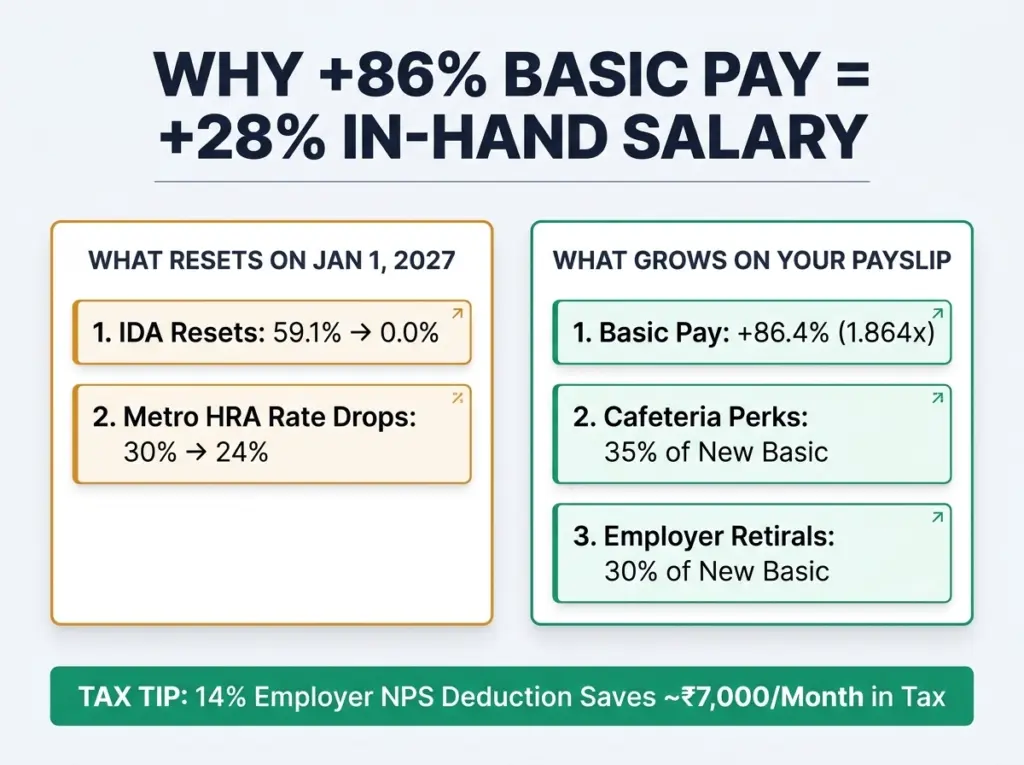
Most people don’t realize how much the new basic pay reshapes every other line on a PSU salary slip. Three big buckets sit on top of your basic salary:
- Cafeteria Perks (Up to 35% of Basic Pay): This is a flexible cash bucket where you pick allowances for things like children’s education, fuel, domestic help, or professional books. Because it is tied directly to Basic Pay, your 35% perk payout shoots up by 86.4% overnight at a 15% fitment. Under the new income tax rules, almost all of these cash allowances are taxed just like regular salary.
- House Rent Allowance (HRA): Right now, because IDA crossed 50% in early 2026, officers in big metro (“X-class”) cities get 30% of their old basic pay as HRA (20% in mid-sized Y cities, 10% in smaller Z towns). On January 1, 2027, when IDA resets to 0%, HRA drops back to 24%, 16%, and 8% (until new IDA crosses 25% and 50% years down the road). Even with the percentage drop from 30% to 24%, your actual cash HRA still grows by 49.1% because 24% of your new, much larger basic pay beats 30% of the old one.
- Retirement & Annual Bonus (PRP): Your employer puts 30% of (Basic + IDA) into your retirement accounts every month (12% into Provident Fund, 4.81% toward gratuity, and the rest into pension and post-retirement medical care). Then there is Performance Related Pay (PRP), the annual profit-sharing bonus. The maximum bonus ceiling is 40% of Basic Pay for E0 to E3, 50% for E4 and E5, 60% for E6, 70% for E7, 80% for E8, 90% for E9, and 100% to 150% for Board Directors. Honestly, very few people see the full bonus amount because of the “Bell Curve” rule, which forces management to give the top performance rating to no more than 15% of staff.
The side-by-side payslip comparison below shows how an officer in a metro city fares from December 2026 (at 59.1% IDA) to January 2027 (at 15% fitment and 0% IDA):
| Monthly Payslip Line | E1 (Asst. Engr / MT) Dec 2026 → Jan 2027 | E2 (Engineer / Officer) Dec 2026 → Jan 2027 | E3 (Sr. Engr / Dy. Mgr) Dec 2026 → Jan 2027 | E4 (Manager) Dec 2026 → Jan 2027 | E6 (Dy. General Mgr) Dec 2026 → Jan 2027 |
|---|---|---|---|---|---|
| Basic Pay | ₹40,000 → ₹74,570 | ₹50,000 → ₹93,210 | ₹60,000 → ₹1,11,850 | ₹70,000 → ₹1,30,500 | ₹90,000 → ₹1,67,780 |
| IDA (59.1% → 0%) | ₹23,640 → ₹0 | ₹29,550 → ₹0 | ₹35,460 → ₹0 | ₹41,370 → ₹0 | ₹53,190 → ₹0 |
| Cafeteria Perks (35%) | ₹14,000 → ₹26,100 | ₹17,500 → ₹32,624 | ₹21,000 → ₹39,148 | ₹24,500 → ₹45,675 | ₹31,500 → ₹58,723 |
| Metro HRA (30% → 24%) | ₹12,000 → ₹17,897 | ₹15,000 → ₹22,370 | ₹18,000 → ₹26,844 | ₹21,000 → ₹31,320 | ₹27,000 → ₹40,267 |
| GROSS MONTHLY PAY | ₹89,640 → ₹1,18,567 (+₹28,927 / +32.3%) | ₹1,12,050 → ₹1,48,204 (+₹36,154 / +32.3%) | ₹1,34,460 → ₹1,77,842 (+₹43,382 / +32.3%) | ₹1,56,870 → ₹2,07,495 (+₹50,625 / +32.3%) | ₹2,01,690 → ₹2,66,770 (+₹65,080 / +32.3%) |
| Less: Employee PF (12%) & Welfare | -₹9,137 → -₹10,448 | -₹11,046 → -₹12,685 | -₹12,955 → -₹14,922 | -₹14,864 → -₹17,160 | -₹18,683 → -₹21,634 |
| Less: Monthly Income Tax | ₹0 → -₹7,131 | -₹5,803 → -₹12,679 | -₹9,688 → -₹19,930 | -₹14,619 → -₹29,129 | -₹27,269 → -₹49,215 |
| NET IN-HAND PAY (Monthly) | ₹80,503 → ₹1,00,988 (+₹20,485 / +25.4%) | ₹95,201 → ₹1,22,840 (+₹27,639 / +29.0%) | ₹1,11,817 → ₹1,42,990 (+₹31,173 / +27.9%) | ₹1,27,387 → ₹1,61,206 (+₹33,819 / +26.5%) | ₹1,55,738 → ₹1,95,921 (+₹40,183 / +25.8%) |
| Total Annual CTC (with Retirals & Max Bonus) | ₹14.97 L → ₹20.49 L | ₹18.71 L → ₹25.61 L | ₹22.45 L → ₹30.74 L | ₹27.03 L → ₹37.43 L | ₹35.84 L → ₹50.13 L |
Here is a practical move you can make yourself once the new pay kicks in: look at the E1 column. Before the hike, an E1 officer’s taxable pay sits below ₹12 lakh, so they pay zero income tax. After the hike, gross pay crosses ₹14.2 lakh, triggering ₹7,131 a month in tax.
If your company lets you route up to 14% of your employer retirement contribution into the National Pension System (NPS), you can legally deduct that amount even under the new tax regime, wiping out almost that entire tax bill and putting another ₹7,000 a month back into your pocket.
Non-Executive Workmen, Supervisors & Coal India’s NCWA-XII
If you work as a plant technician, operator, or diploma supervisor, your raise does not come from the executive pay committee. Instead, your union negotiates a binding wage settlement directly with company management, similar to how bank unions negotiate their 13th Bipartite Settlement.
There is one strict government rule management cannot break during these talks: a senior supervisor or workman’s new pay scale cannot overlap with or beat the starting pay of an entry-level officer in that same company.
At Coal India and Singareni Collieries (SCCL), roughly 2.6 lakh coal miners follow a 5-year wage cycle called the National Coal Wage Agreement (NCWA). Their 11th agreement (which gave a 19% guaranteed hike and raised the minimum basic pay of a Category-I worker to ₹39,069 a month) expired on June 30, 2026.
For the upcoming NCWA-XII (effective July 1, 2026), merging ~23.2% accumulated coal DA and adding a negotiated 15% to 19% benefit will push a Category-I miner’s starting basic pay to ₹55,380–₹57,330 a month, while top Grade-A1 supervisors will move from ₹71,060 to ₹1,00,650–₹1,04,170.
In almost all other major PSUs like NTPC, PGCIL, BHEL, HAL, BEL, and Indian Oil, workmen and supervisors follow a 10-year cycle due on January 1, 2027. At a 15% fitment (1.864x), standard non-executive scales will shift as follows:
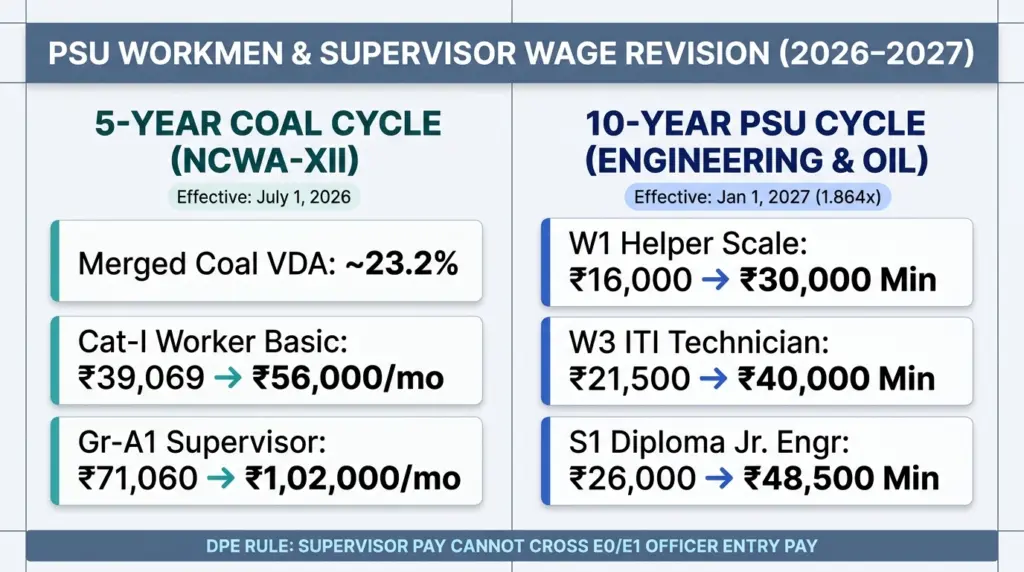
- W1 (Unskilled Helper/Attendant): ₹16,000–50,000 → ₹30,000 – ₹93,000
- W3 (ITI Technician / Fitter / Operator): ₹21,500–74,000 → ₹40,000 – ₹1,38,000
- W8 (Master Craftsman / Chargehand): ₹27,500–96,000 → ₹51,300 – ₹1,79,000
- S1 (Junior Engineer / Diploma Entry): ₹26,000–1,00,000 → ₹48,500 – ₹1,86,500
- S4 (Chief Foreman / Top Supervisor): ₹35,000–1,20,000 → ₹65,200 – ₹2,24,000
Will Your PSU Afford the Full 15% Hike? (14-Company Profit Check)
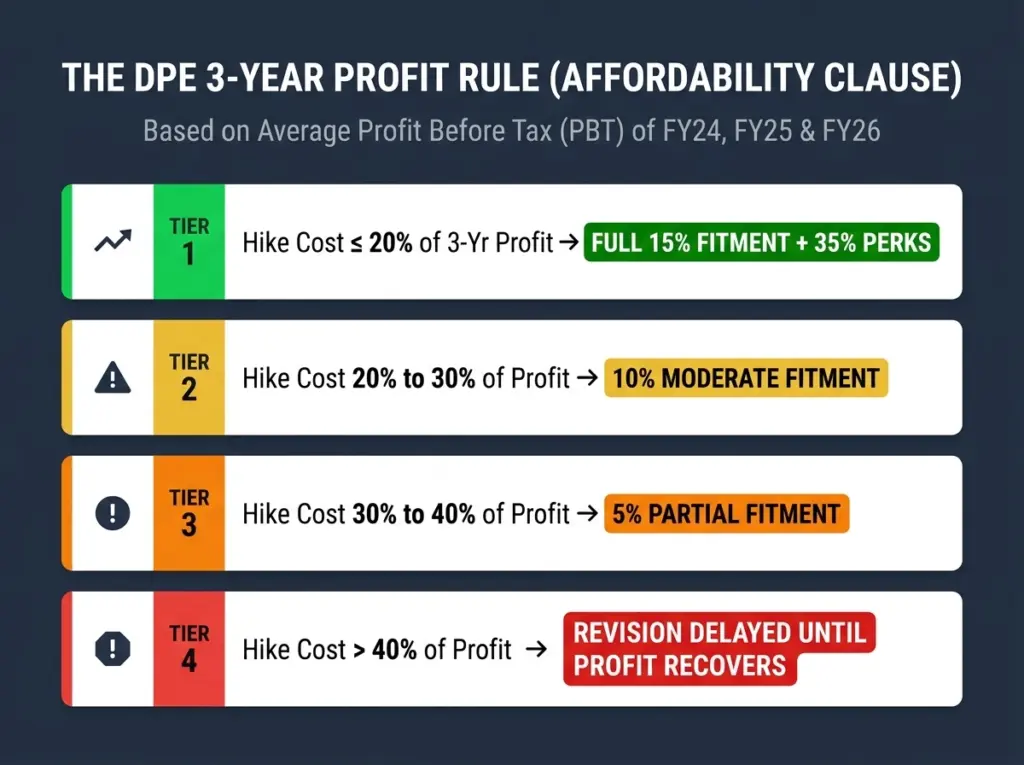
We covered the government’s affordability formula in our 4th PRC policy and fitment guide, but the core rule is simple: the extra yearly cost of your pay hike cannot exceed 20% of your company’s average pre-tax profit (PBT) over the last three financial years (FY24, FY25, and FY26). If the cost crosses 20%, fitment drops to 10% or 5%.
Looking at the audited FY24–FY26 balance sheets of 14 major public sector companies reveals a sharp split between cash-rich energy/defence giants and heavy manufacturing firms:
| PSU Name | Category | 3-Yr Avg Pre-Tax Profit (FY24–26) | 20% Profit Limit (Max Hike Budget) | Est. Annual 4th PRC Cost (@15%) | Cost as % of 3-Yr Profit | Expected Fitment Tier | Entry Grade for Freshers (Old → New Basic) |
|---|---|---|---|---|---|---|---|
| ONGC | Maharatna | ₹47,397 Cr | ₹9,479 Cr | ~₹1,650 Cr | 3.5% | 15% (Full) | E1* (₹60k → ₹1,12,000) |
| Coal India | Maharatna | ₹45,883 Cr | ₹9,177 Cr | ~₹1,080 Cr (Officers) | 2.4% | 15% (Full) | E2 (₹50k → ₹93,000; E3 in Yr 2) |
| IOCL | Maharatna | ₹39,003 Cr | ₹7,801 Cr | ~₹2,050 Cr | 5.3% | 15% (Full) | E2 (₹50k → ₹93,000) |
| BPCL | Maharatna | ₹28,105 Cr | ₹5,621 Cr | ~₹700 Cr | 2.5% | 15% (Full) | E2 (₹50k → ₹93,000) |
| NTPC | Maharatna | ₹23,246 Cr | ₹4,649 Cr | ~₹1,110 Cr | 4.8% | 15% (Full) | E1 (₹40k → ₹75,000) |
| PGCIL | Maharatna | ₹18,562 Cr | ₹3,712 Cr | ~₹505 Cr | 2.7% | 15% (Full) | E1 (Trainee ₹75k) → E2 (₹93,000) |
| HPCL | Maharatna | ₹17,180 Cr | ₹3,436 Cr | ~₹660 Cr | 3.8% | 15% (Full) | E2 (₹50k → ₹93,000) |
| HAL | Maharatna | ₹11,068 Cr | ₹2,214 Cr | ~₹1,120 Cr | 10.1% | 15% (Full) | E1 (Trainee ₹75k) → E2 (₹93,000) |
| BEL | Navratna | ₹6,813 Cr | ₹1,363 Cr | ~₹435 Cr | 6.4% | 15% (Full) | E-II* (₹40k → ₹75,000) |
| NHPC | Navratna | ₹4,548 Cr | ₹910 Cr | ~₹310 Cr | 6.8% | 15% (Full) | E2 (₹50k → ₹93,000) |
| SCCL | Joint PSU | ~₹3,017 Cr | ~₹603 Cr | ~₹175 Cr (Officers) | 5.8% | 15% (Full) | E2 (₹50k → ₹93,000; E3 in Yr 2) |
| RITES | Navratna | ₹606 Cr (Consol) | ₹121 Cr | ~₹85 Cr (IDA Core) | 14%–18.5% | 15% (Tight) / 10% | E1 (₹40k → ₹75,000) |
| BEML | Miniratna-I | ₹329 Cr | ₹66 Cr | ~₹160 Cr | 48.6% | 5% / 10% (or delay) | E1 (Trainee ₹75k) → E2 (₹93,000) |
| BHEL | Maharatna | ₹1,028 Cr | ₹206 Cr | ~₹1,050 Cr | 102.1% | 5% now (or 15% if delayed to FY28/29) | E1 (Trainee ₹75k) → E2 (₹93,000) |
*Note: ONGC calls the ₹60,000 scale “E1” (which matches E3 elsewhere), and BEL calls the ₹40,000 scale “E-II”.
Look closely at BHEL at the bottom of that list. BHEL is pulling off a massive business turnaround right now, with pre-tax profits jumping from ₹243 crore in FY24 to ₹725 crore in FY25, and hitting ₹2,116 crore in FY26 on a ₹2.40 lakh crore order book. That’s the tricky part. Because BHEL has a huge ₹5,923 crore staff payroll, a 15% hike costs roughly ₹1,050 crore a year.
Measured against its ₹1,028 crore three-year average profit (dragged down by FY24), BHEL would only qualify for a 5% hike in early 2027. In reality, BHEL’s Board will almost certainly wait until FY2028-29 to sign off on the revision, letting the weak FY24 profit drop out of the three-year window so employees can get the full 10% or 15% fitment.
BEML faces a similar timing crunch, while consultancy firm RITES sits right on the 15% borderline only because many of its engineers are railway deputationists whose salaries are billed directly to clients.
What Happens Next for Your Paycheck
Nobody will see these new numbers on their January 2027 payslip right away. Because the government waits for the 8th Central Pay Commission to set the baseline before finalizing PSU guidelines, official 4th PRC orders are only expected to land in late 2027 or early 2028. The good news is that the effective date stays locked at January 1, 2027.
Every month the paperwork takes is another month of backdated arrears building up in your favor. For now, you do not need to file anything—just keep track of your basic pay increments and make sure your NPS and tax elections are set up before the lump-sum arrears arrive.


Leave a Reply