
Every time headlines heat up about the 8th Central Pay Commission, bank WhatsApp groups fill up with the same anxious question: how much will our salaries go up? Honestly, if you work at State Bank of India, any of the other 11 public sector banks, a regional rural bank, or the Reserve Bank of India, the short answer is that the 8th Pay Commission does not cover you at all.
Your paycheck runs on a completely separate track. Instead of waiting ten years for a government panel, public sector bank staff get pay revisions every five years through direct union negotiations. Right now, bank salaries follow the 12th Bipartite Settlement through October 31, 2027, with the 13th Bipartite Settlement scheduled to kick in on November 1, 2027. Knowing how the 8th Pay Commission applies to bank and PSU employees keeps you from banking on the wrong timeline or misjudging a job offer.
Why the 8th Pay Commission skips bank staff and how bank pay actually works
When the Union Cabinet cleared the official rulebook (Terms of Reference) on October 28, 2025, and the Finance Ministry formally set up the three-member 8th Pay Commission on November 3, 2025 under retired Justice Ranjana Prakash Desai, Part-Time Member Prof. Pulak Ghosh, and Member-Secretary Pankaj Jain, the boundaries were drawn in black and white.
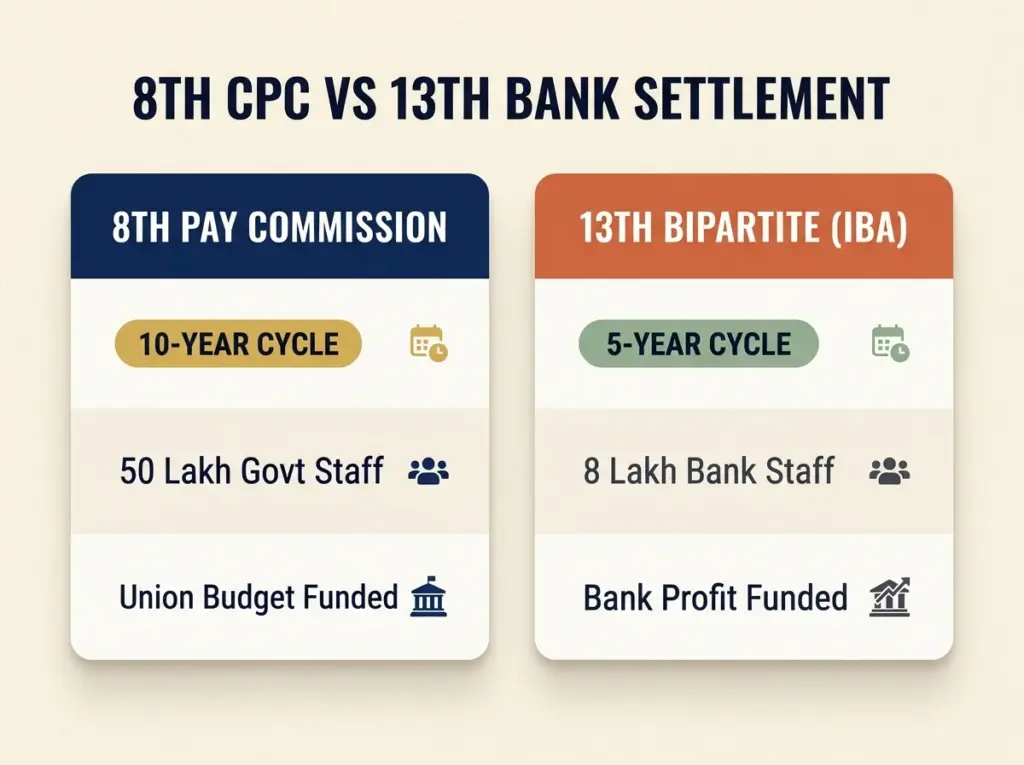
That panel only reviews pay for roughly 50 lakh central government civilian staff, defense personnel, railway workers, All India Services officers, and Union Territory employees, along with 65 to 69 lakh pensioners whose money comes straight out of the central government budget.
Public sector banks are different animals. Even though the government owns 51% or more of their shares, they operate as commercial lenders regulated by the RBI, not government ministries. Because bank employees earn their salaries from each bank’s own operating income rather than taxpayer funds, they fall outside the central pay commission system, much like the separate framework covered in the 2027 PSU pay revision and 4th PRC guide.
So how do bank salaries actually go up? Every five years, the Indian Banks’ Association (IBA), representing bank management, sits down across the table from nine recognized unions grouped under the United Forum of Bank Unions (UFBU), which splits into five unions for clerical and subordinate staff and four associations for officers.
Under national labor law, the deal they sign for clerks and subordinate staff is called a Bipartite Settlement (literally a two-sided binding contract), while the parallel agreement for Scale I to VII officers is called a Joint Note, which takes effect once each bank updates its internal officer service rules.
Right now, your salary slip reflects the 12th Bipartite Settlement and 9th Joint Note, signed in Mumbai on March 8, 2024 and covering the five-year window from November 1, 2022 to October 31, 2027. That agreement covers 25 banks that gave the IBA authority to negotiate for them (12 public sector banks, 10 private banks, and 3 foreign banks: Citibank, HSBC, and Standard Chartered for clerical staff), employing roughly 8 lakh people, half of whom are clerical and subordinate workmen.
It raised payslip costs by 17% across public sector banks, adding ₹12,449 crore to the annual wage bill (₹4,165 crore for workmen and ₹8,284 crore for officers), with a 3% load going toward basic pay after folding in older inflation allowances.
Under this deal, a new clerk starts at ₹24,050 basic pay (scaling up to ₹64,480), and a Scale I officer starts at ₹48,480 (climbing as high as ₹1,73,860 in top officer grades).
Most people don’t realize how two technical rules in that 2024 deal quietly shape their monthly take-home pay and retirement savings. First, banks folded accumulated Dearness Allowance (DA, the cost-of-living payout that offsets inflation) corresponding to 8088 price index points into basic pay and shifted the calculation to a newer 2016 consumer price index base over 123.03 points, paying 1% DA for every point above that mark.
Unlike central government staff who wait six months (January and July) for inflation updates, bank DA adjusts every three months in February, May, August, and November, putting bank DA at 31.33% for the November 2026 to January 2027 quarter. Second, banks channel a big chunk of pay through a “Special Allowance” (26.50% of basic pay for workmen and Scale I officers, rising to 31.50% for Scale VI and VII officers).
That allowance earns DA every month, which looks great on your net pay, but there is a catch: it does not count toward your Provident Fund, National Pension System (NPS), pension, or gratuity.
The road to November 2027 and why the government wants no more three-year delays
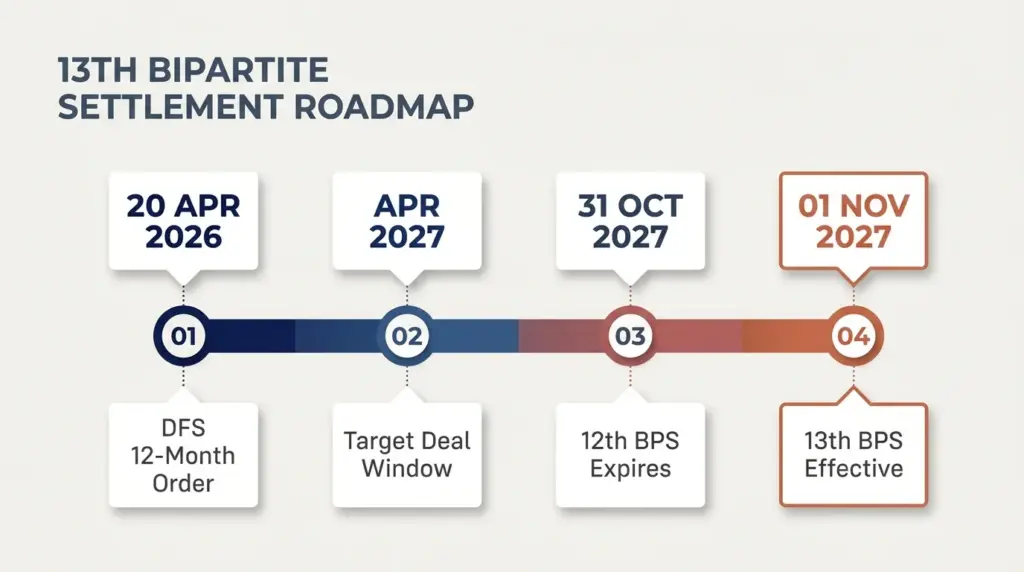
If you have worked in a public sector bank for more than a few years, you know the biggest headache isn’t just the size of the raise. It is waiting years after the due date to actually see the money in your account. The 11th settlement was due on November 1, 2017, yet talks dragged on for three full years until November 2020. The 12th settlement cut that wait down to 16 months, finally getting signed in March 2024 with back pay (arrears) paid in installments going back to November 2022.
This time, the Finance Ministry wants the deal done before the clock runs out. On April 20, 2026, the Department of Financial Services sent a formal order instructing public sector banks and the IBA to start early and finish negotiations for the 13th Bipartite Settlement and 10th Joint Note within 12 months (aiming for April 2027).
That gives individual bank boards enough breathing room to amend their internal service regulations before the new five-year cycle begins on November 1, 2027 (running through October 31, 2032).
Here is what happens behind the scenes versus what you can actually do as an employee. Individual clerks and officers don’t file legal notices or bargain directly with management; your practical role right now is feeding ground-level demands through your union branch. By July 5, 2026, for instance, AIBEA working groups had already sorted through 1,025 member suggestions after UFBU, AIBEA, BEFI, and NCBE kicked off drafting work in late June 2026.
Union leaders and IBA negotiators handle the heavy procedural work of turning those inputs into a unified Charter of Demands and hammering out bank mandates.
Before the 13th settlement talks even hit full stride, unions and the IBA had to defuse a strike threat on September 27, 2026 by signing an agreement to reopen several unfinished fights from the last round. Top of the list is five-day banking: the March 2024 settlement agreed to close banks on all Saturdays in exchange for adding roughly 40 minutes to weekday shifts, a move that still awaits final central government and RBI approval as of November 2026.
The September 2026 talks also put long-standing retirement grievances back on the table, including updating older defined-benefit pensions automatically whenever wages rise (instead of handing retirees a flat monthly ex-gratia payment), giving newer NPS-covered staff a chance to switch to the older DA-linked pension plan, applying uniform 8088-point DA relief for pensioners, removing caps on one-month-pay gratuity rules, and fixing performance-linked incentive (PLI) and promotion pay gaps.
Side-by-side pay numbers and how the 8th Pay Commission still pressures bank talks
Even though the 8th Pay Commission has zero legal authority over banks, its calendar collides directly with the 13th Bipartite Settlement. After wrapping up online submissions in May 2026 and finishing regional hearings in Bengaluru and Mumbai in October 2026, Justice Desai’s commission is expected to hand in its final report around May 2027, right inside the 12-month window for bank wage talks.
Right now, under November 2026 rates (31.33% DA for bank staff and 63% DA for central government staff after the Cabinet’s October 28, 2026 hike effective July 1, 2026), starting pay in public sector banks actually holds an edge over comparable central government posts.
You can run your own numbers on the 8th Pay Commission salary calculator or check how analysts model the multiplier in this breakdown of 8th Pay Commission fitment factor estimates. Because the original source table scrambled a few allowance lines between clerks and officers and had currency symbol glitches, here is the verified, corrected breakdown of November 2026 monthly gross pay alongside projected 8th CPC basic pay ranges:
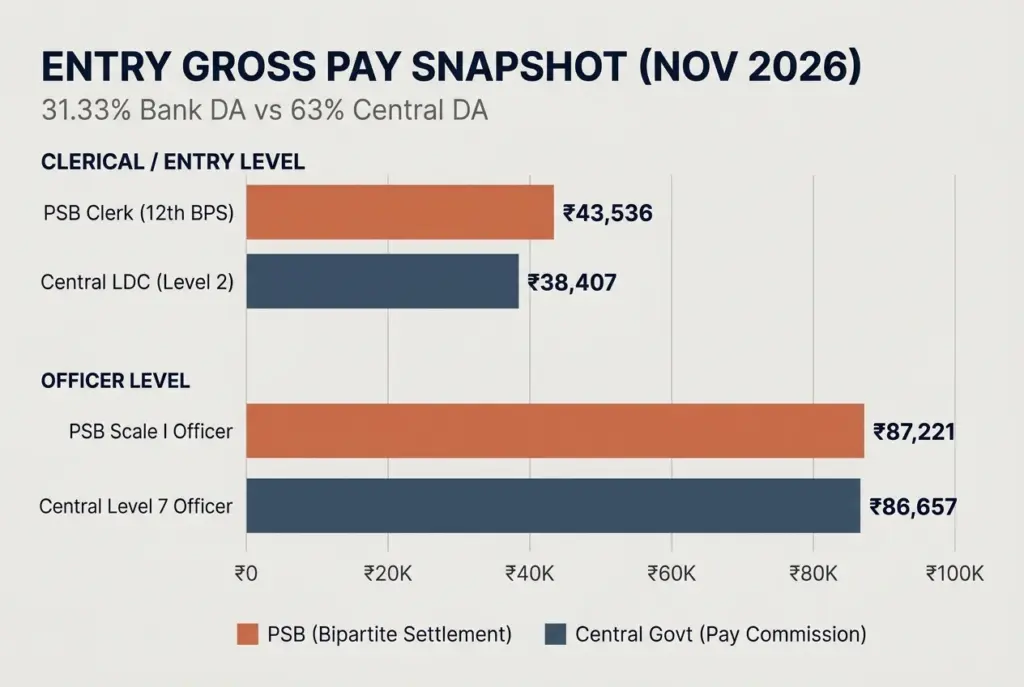
| Role or Pay Level | Nov 2026 Basic Pay | Allowances in Snapshot | Nov 2026 Actual Gross Pay | 8th CPC Basic Pay Estimate |
|---|---|---|---|---|
| PSB Clerk / CSA (12th BPS) | ₹24,050 | Special Allow ₹6,373.25, TA ₹850, DA ₹9,797.91, HRA ₹2,465.13 | ₹43,536 | Not applicable (13th BPS due Nov 2027) |
| PSB Officer Scale I / PO (9th JN) | ₹48,480 | Special Allow ₹12,847.20, Learning ₹850, DA ₹19,480.12, HRA 9% to 10% | ₹86,505 to ₹87,221 | Not applicable (10th JN due Nov 2027) |
| Central Govt Level 1 (MTS) | ₹18,000 | DA 63% (₹11,340), HRA 20% Y to 30% X | ₹32,940 to ₹34,740 | ₹34,560 (1.92x) to ₹51,480 (2.86x) |
| Central Govt Level 2 (LDC) | ₹19,900 | DA 63% (₹12,537), HRA 20% Y to 30% X | ₹36,417 to ₹38,407 | ₹38,208 (1.92x) to ₹56,914 (2.86x) |
| Central Govt Level 4 (PA/TA) | ₹25,500 | DA 63% (₹16,065), HRA 20% Y to 30% X | ₹46,665 to ₹49,215 | ₹48,960 (1.92x) to ₹72,930 (2.86x) |
| Central Govt Level 6 | ₹35,400 | DA 63% (₹22,302), HRA 20% Y to 30% X | ₹64,782 to ₹68,322 | ₹67,968 (1.92x) to ₹1,01,244 (2.86x) |
| Central Govt Level 7 (Inspector/ASO) | ₹44,900 | DA 63% (₹28,287), HRA 20% Y to 30% X | ₹82,167 to ₹86,657 | ₹86,208 (1.92x) to ₹1,28,414 (2.86x) |
| Central Govt Level 10 (Group A) | ₹56,100 | DA 63% (₹35,343), HRA 20% Y to 30% X | ₹1,02,663 to ₹1,08,273 | ₹1,07,712 (1.92x) to ₹1,60,446 (2.86x) |
Look at what happens to recruitment competition if the 8th Pay Commission lands well. In August 2026, the government told Parliament that no fitment factor (the multiplier used to recalculate basic pay), pay matrix, or binding start date has been finalized yet, even though past commissions followed a ten-year cycle pointing to January 1, 2026. Back in the 7th Pay Commission, the government folded 125% DA into basic pay using a 2.57x multiplier.
For the 8th CPC, independent analysts float multipliers between 1.92x and 2.86x, while staff unions (NC-JCM) are asking for 3.83x, with accumulated DA resetting to zero once the new basic pay takes effect. If central government Level 4, Level 7, and Group A Level 10 salaries jump sharply, bright graduates who pass both IBPS bank exams and SSC or UPSC tests won’t stick around in banking unless the 13th Bipartite Settlement keeps pace.
And bank unions have serious ammunition this time. Public sector banks entered 2026 on the back of all-time high FY 2025-26 financial numbers, posting ₹3.21 lakh crore in operating profit and ₹1.98 lakh crore in net profit, while bad loans (Gross NPAs) fell to a historic low of 1.93% and net bad loans dropped to 0.39%.
Armed with those profits and pointing to the central government’s Unified Pension Scheme (which guarantees 50% of pay as pension after 25 years of service), unions are expected to demand a 25% to 30% wage hike. Bank boards, however, usually open negotiations closer to 12% to 15%. Why the caution? Operating expenses still eat up nearly half of bank income (a 49.67% cost-to-income ratio), banks must keep over 90% cash reserves set aside to cover bad loans, and boards have to protect their 16.6% capital safety cushion above the 11.5% regulatory minimum.
Folding too much money directly into basic pay permanently inflates pension and provident fund bills, which is why management pushes so hard to put extra raises into Special Allowance instead.
Where RRB, RBI, NABARD, private bank, and insurance staff stand
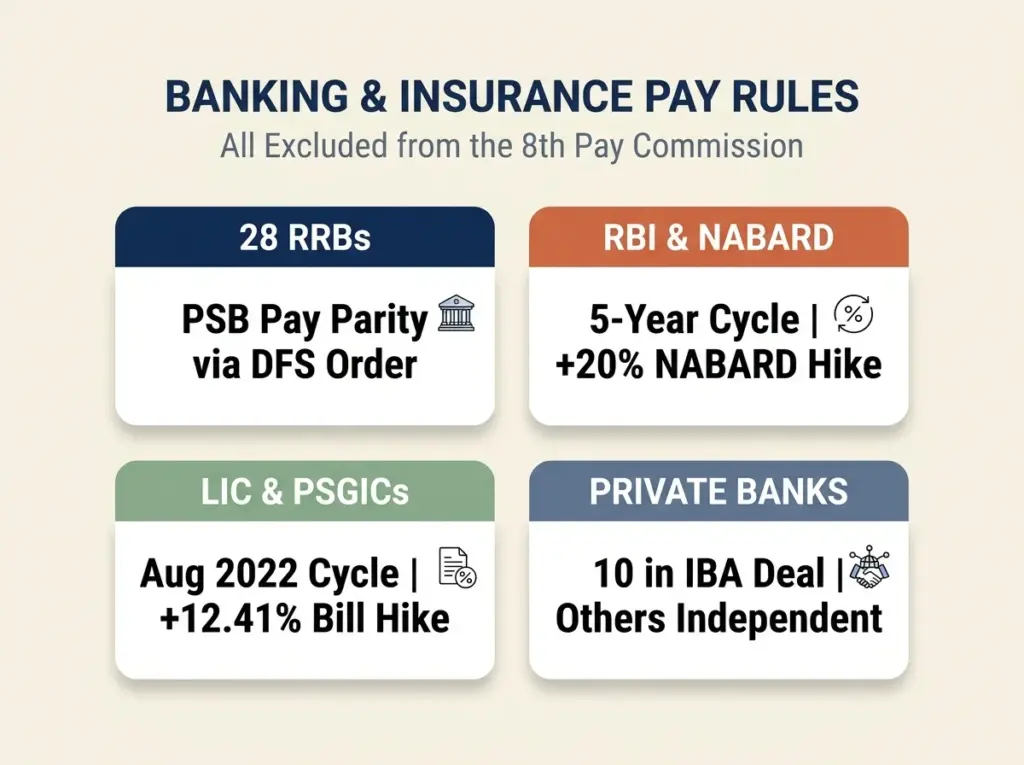
Not everyone working in finance sits under the same umbrella, and mixing these rules up causes endless confusion during wage talks.
- Regional Rural Banks (RRBs): Staff across the 28 RRBs (trimmed down from 43 after 26 rural banks merged on May 1, 2025 under the government’s “One State-One RRB” drive across 26 states and 2 Union Territories) are left out of the 8th Pay Commission and do not sit directly at the IBA bargaining table. Still, thanks to a 1990 National Industrial Tribunal award and Supreme Court rulings in 2001, 2002, and 2018, the central government is legally required to give RRB staff the same basic pay scales as nationalized banks. That only happens after each IBA deal is signed, when the Finance Ministry sends a separate implementation order through NABARD (as it did on July 8, 2024 for the 12th settlement), often leaving rural bankers frustrated by wait times and local sponsor-bank allowance differences.
- RBI and NABARD: The November 2025 Gazette notification explicitly carves the Reserve Bank of India out of the 8th Pay Commission, even though other parliamentary regulators are included. Both RBI and NABARD negotiate their own independent five-year pay revisions tied to a November 1, 2022 cycle. On January 23, 2026, the central government approved key pay and pension revisions, granting a 10% increase on basic pension plus inflation relief for RBI retirees and a roughly 20% pay hike effective November 1, 2022 for around 3,800 NABARD employees, alongside pension parity for pre-November 2017 NABARD retirees.
- Private banks and public sector insurers: Outside the 10 private banks and 3 foreign banks that signed onto the 12th Bipartite Settlement, private lenders and small finance banks set salaries entirely on their own. Meanwhile, Life Insurance Corporation (LIC) and public sector general insurers (NICL, NIACL, OICL, UIICL, GIC Re, and AICIL) follow separate five-year Finance Ministry wage rules dating from August 1, 2022; on January 23, 2026, 43,247 general insurance employees received a 12.41% overall wage-bill hike featuring a 14% raise on basic pay plus DA, a 14% employer NPS contribution, and a flat 30% family pension.
If you work in a public sector bank or plan to sit for IBPS and SBI exams, keep your eyes on two practical markers between now and late 2027. First, watch whether the IBA and UFBU hit the Finance Ministry’s April 2027 deadline for the 13th Bipartite Settlement, which will decide whether your November 1, 2027 pay hike arrives on time or turns into another long wait for arrears.
Second, pay close attention to how much of the next bank raise goes into permanent basic pay versus Special Allowance, and whether the RBI clears the five-day workweek before the current agreement expires on October 31, 2027.
Leave a Reply