
Picture two Havildars, same rank, same 24 years of service, retiring thirteen months apart. Normally you’d expect them to draw close to the same pension. But depending on how the government eventually implements the 8th Pay Commission’s recommendations, on when the new pay tables actually take effect, and on how the revised pension formula interacts with OROP, the one who retires after the cutover could end up earning noticeably more, every month, for years.
Nothing about that outcome is locked in yet. It’s a real possibility only because two government systems, running on two different clocks, both apply to the same soldier’s pension, and nobody has said yet exactly how the handover between them will work.
Two systems, two calendars
Military pensions rest on two mechanisms that were never designed to move together. The Pay Commission resets basic pay roughly once a decade, using a fitment factor (a fancy way of saying “multiply the old number by this to get the new one”) and wiping the accumulated cost-of-living adjustment back to zero.
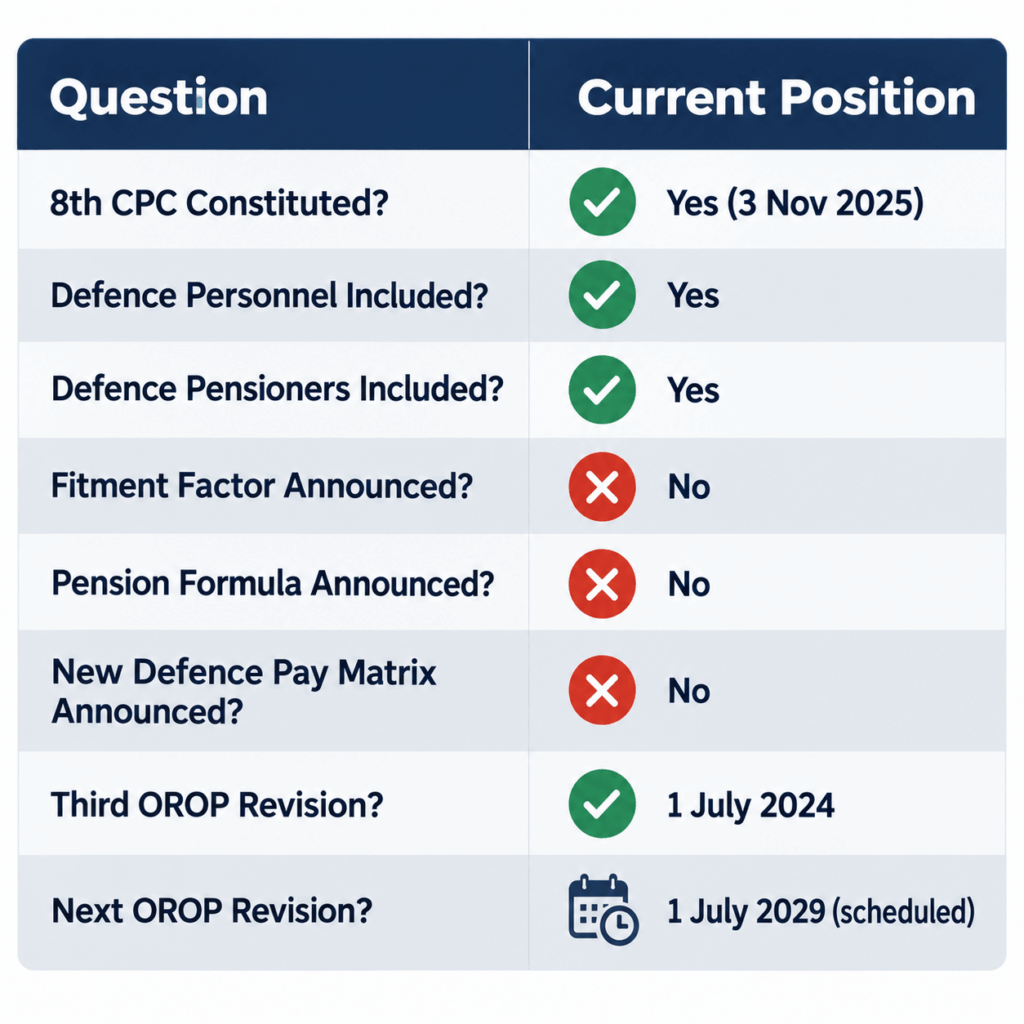
One Rank One Pension, or OROP, works on its own five-year cycle instead, recalculating pensions for people who’ve already retired so a soldier who left service in 2015 isn’t stuck earning less than someone with identical rank and service who left in 2023. OROP has been revised three times so far, most recently with effect from 1 July 2024, using the average pension of that year’s retirees as the baseline. The next revision, under the same five-year policy laid down when OROP was first notified, is due on 1 July 2029.
Here’s the concern, not the conclusion. Once the 8th CPC’s recommendations are actually implemented, whenever that turns out to be, anyone retiring after the new pay scales take effect would have their pension calculated on the new, higher pay matrix. Anyone who retired even a month earlier would keep drawing a pension pegged to the 2024 OROP baseline, topped up periodically by Dearness Relief, until the next scheduled OROP comparison catches their cohort up with more recent retirees, which under the current cycle isn’t due until 2029.
Whether that gap actually opens up, and how wide it would be, depends entirely on the fitment factor the Commission recommends, the pension formula it proposes, the effective date the government adopts, and whether any transitional provision gets built in to bridge the two.
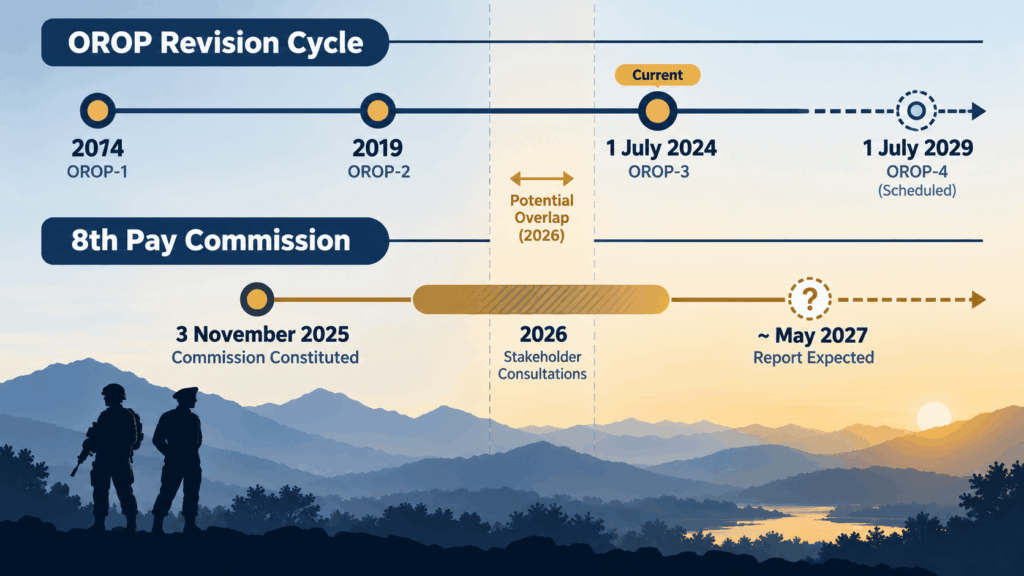
This is not a hypothetical worry sitting only in veterans’ WhatsApp groups. Pensioner and employee bodies, including the All India Defence Employees’ Federation, have formally asked the government to state clearly that pensions of people who retired before 1 January 2026 will also be revised alongside the new pay scales. On 18 August 2026, the Department of Personnel and Training forwarded these representations to the Department of Expenditure, the wing of the finance ministry that actually decides such things. That’s a procedural step, not a decision, and no pension rule has changed as a result.
Separately, veterans’ associations including the Federation of Veterans Association and the Purva Sainik Adhikar Rakshak Mahasangh raised the OROP timing problem directly with the Commission in a memorandum reported in August 2025, asking for the five-year OROP cycle to shrink to two years, or for an annual indexation mechanism instead.
What the multiplier could mean in rupees, and what’s still just a guess
It helps to know that, even now, none of the actual numbers are settled. The Commission, chaired by Justice Ranjana Prakash Desai, a retired Supreme Court judge, was formally constituted through a Gazette notification on 3 November 2025 and given 18 months to submit its report, putting the deadline around May 2027.
Central government employees and pensioners, defence personnel and defence pensioners among them, were able to file formal memoranda with their demands through a portal that closed on 15 June 2026, and the Commission has spent 2026 holding consultation sessions across the country, including recent visits to Jaipur, Chennai, Puducherry, and Chandigarh. As of the most recent updates, the Commission has not announced a fitment factor, a pension formula, or a new Defence Pay Matrix.
The “1 January 2026” date that keeps circulating is only the reference date pay commissions have traditionally been backdated to once their recommendations are approved, similar to how the 7th CPC’s report, submitted in late 2015, was still applied retroactively to January 2016.
It has not, so far, been confirmed as this commission’s effective date. (Pensioners did see one small, unrelated change take effect that month: Dearness Relief rose from 58% to 60% of existing pension under the current 7th CPC rules, which has nothing to do with whatever the 8th CPC eventually recommends.)
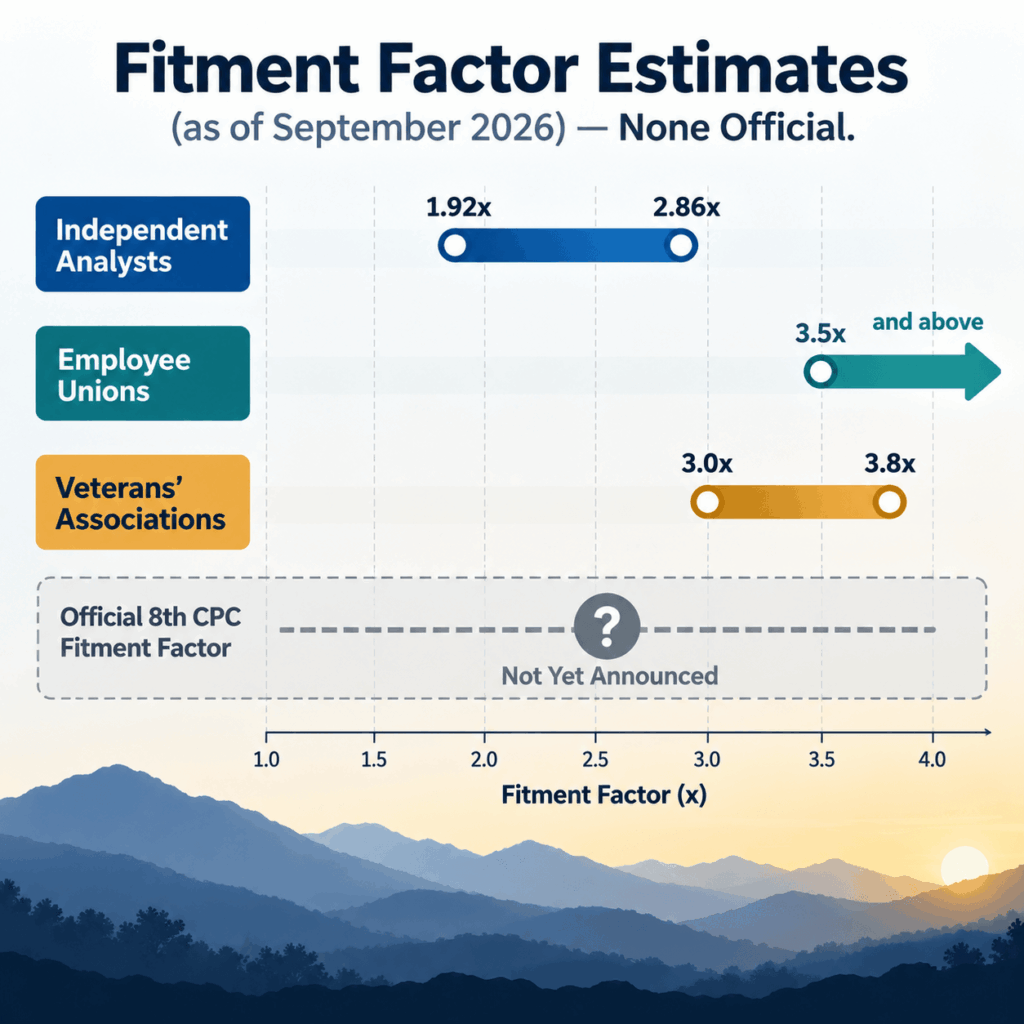
With no official number to go on, estimates vary depending on who’s doing the guessing, and it’s worth keeping these separate rather than treating any of them as settled:
- Independent financial analysts have floated a fitment factor somewhere in the broad range of 1.92x to 2.86x, with a number of estimates clustering around 2.28x to 2.46x.
- Central government employee unions have pushed for a higher figure, in some cases above 3.5x.
- Veterans’ associations specifically, including the two groups mentioned above, have asked for a defence pension multiplier of 3.0x to 3.8x.
- None of these is the Commission’s position. The Commission itself has not stated a number.
To see what a multiplier actually does to a rupee figure, without treating this as a forecast: a Sepoy’s current OROP-3 basic pension is ₹20,463 a month. Multiply that by 2.28, purely as arithmetic, and you get roughly ₹46,656. Multiply it by 3.0 instead, closer to what veterans’ groups are asking for, and you get roughly ₹61,389.
Run the same two multipliers against a Havildar’s current basic pension of ₹24,763 and you land somewhere between roughly ₹56,460 and ₹74,289. This is illustrative math, not a projection of what will happen. It also doesn’t resolve a real open question: which baseline figure the eventual formula will actually apply to for pre-2026 retirees.
If terms like “fitment factor” or “reckonable emoluments” are new to you, our 8th Pay Commission glossary breaks the rest of the jargon down in plain language.
Same risk, different pay
There’s a second, older dispute that has nothing to do with the fitment factor. Military Service Pay, the extra monthly amount meant to compensate for the hazards and early retirement unique to army life, was set by the 7th CPC in 2017 at ₹15,500 for commissioned officers, ₹10,800 for Military Nursing Service officers, and ₹5,200 for JCOs and other ranks.
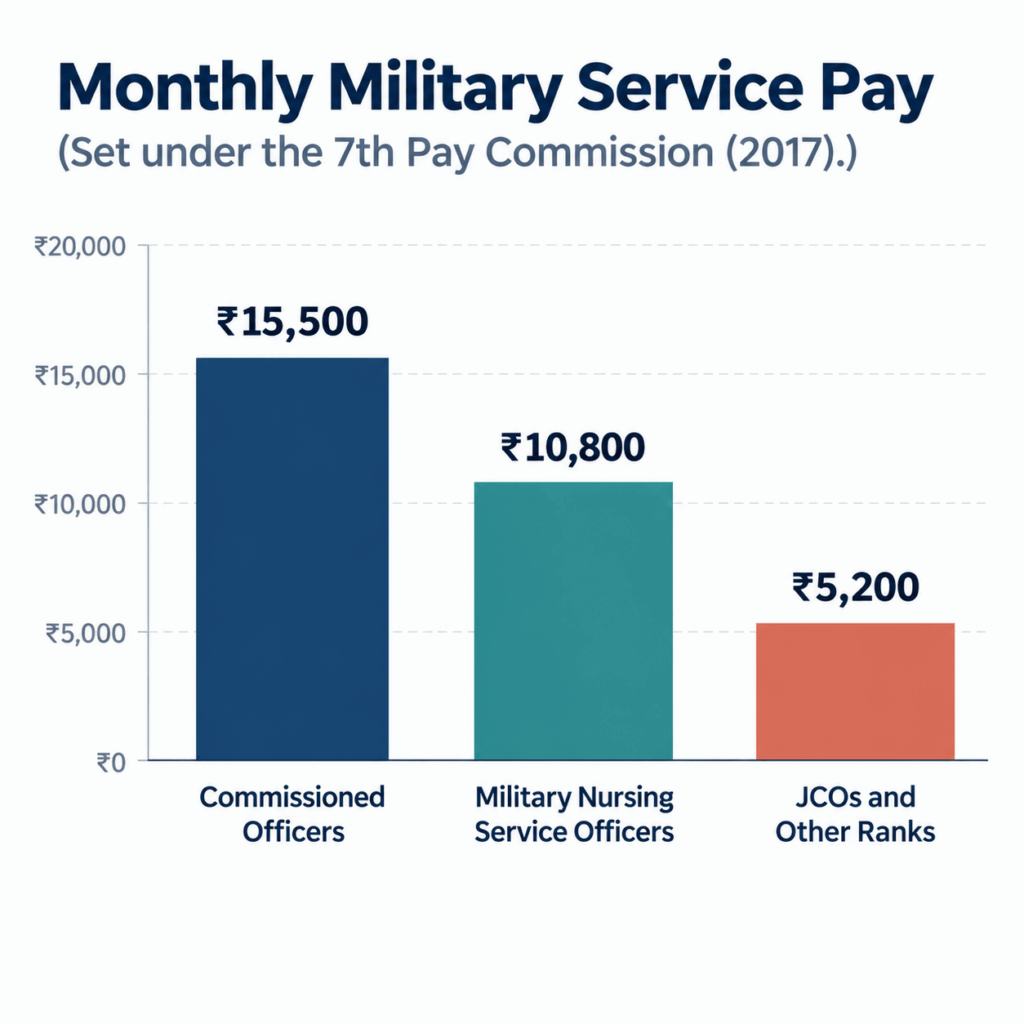
That’s a big gap for people who often face similar field postings and combat exposure. Jawans took the issue to the Delhi High Court, arguing it violated their right to equal treatment under the Constitution. In September 2024, the court dismissed the petitions, ruling that setting pay classifications is the job of expert Pay Commissions, not courts, and that MSP was designed to reflect more than just physical hardship.
That leaves the question open for policy, not litigation, to settle. Veterans’ groups have raised the MSP gap in their representations to the 8th CPC, and a Pay Commission is free to look at that kind of issue, but nothing obliges it to, and whatever it eventually recommends would still need the government’s separate approval before it changed a single rupee for serving or retired personnel.
A quieter change to disability pensions
In September 2023, the Ministry of Defence issued new Entitlement Rules and a Guide to Medical Officers governing disability compensation for the armed forces, replacing a framework that had stood since 2008. For soldiers invalided out of service early because of an injury, nothing changed: they still get a Disability Pension made up of a Service Element plus a Disability Element.
For a soldier who’s hurt, kept on, and completes their full term anyway, the equivalent payment was renamed “Impairment Relief.” According to the government’s own FAQ on the change, this is a rename only: Impairment Relief is stated to be the same as the old Disability Element, at the same rate, introduced purely to distinguish it from the Disability Element paid to those who are invalided out of service. The Ministry has repeatedly said there are no policy or entitlement changes in the revised rules.
Not everyone is satisfied with that framing. Some veterans’ groups argue that describing the payment as something other than a pension could open the door to different tax or survivor-benefit treatment down the line, even if the rate itself hasn’t moved, and have asked the 8th CPC to look at the distinction directly. Whether that concern ever materialises isn’t settled either way, and it’s a genuinely contested point rather than an established fact.
What is clear is that disability pension claims remain a live legal battleground. In a significant ruling on 15 September 2026, the Supreme Court dismissed around 271 appeals the government had filed against soldiers who had won disability pension claims under the older 2008 Rules, in Union of India v. Col. N.C. Isaac (Retd.) and connected matters.
The Court reaffirmed that the burden generally sits with the government to disprove a service connection, not with the soldier to prove one, a principle that traces back to the Supreme Court’s 2013 Dharamvir Singh ruling. But the Court also clarified that Dharamvir Singh, decided under still-earlier 1982 rules, shouldn’t be applied automatically to cases under the 2008 framework, and that claims filed more than 15 years after discharge shift the burden onto the veteran instead.
What this actually means for you
These threads, the fitment factor, the OROP timing question, the MSP gap, and the disability pension rules, aren’t all decided in the same place, even though they can feel like one tangle. The fitment factor and the overall pension formula are squarely the 8th CPC’s call to recommend.
The OROP cycle is set by a standing Ministry of Defence policy that the Commission could comment on but doesn’t itself control. MSP and the disability pension rules sit with the Ministry of Defence and, where they’re being actively litigated, with the courts and the Armed Forces Tribunal. The Commission’s report, once it lands, will shape parts of this picture, but the government still has to examine, accept, modify, or implement whatever it recommends, and several of these questions will keep moving through their own separate channels regardless of what that report says.
Here’s where things actually stand as of this writing:
If you’re within a year or two of retirement, when exactly you leave service could end up mattering more than usual this time, but that depends on the fitment factor the Commission eventually recommends, the effective date the government adopts, how the pension formula gets applied to pre-cutover and post-cutover retirees, and whether any transitional fix gets built in to handle the OROP overlap.
None of that is decided yet, which is exactly why it’s worth tracking rather than assuming either way. Worth keeping an eye on the confirmed dates and milestones we’re tracking as the Commission’s work moves forward. And if you’re a central government employee rather than a defence pensioner, our 8th Pay Commission guide for teachers covers the civilian side of this same process.
Once the Commission actually names a fitment factor, you can run your own numbers through our 8th Pay Commission calculator.
Leave a Reply