If you work in a Central Public Sector Enterprise (CPSE), you already know the current 10-year pay cycle officially wraps up on December 31, 2026. A lot of employees assume a brand-new salary structure will kick in automatically on New Year’s Day.
Honestly, it won’t. As of mid-November 2026, the government hasn’t even formed the 4th Pay Revision Committee (4th PRC). That means your January 2027 paycheck bump will come entirely from your regular quarterly cost-of-living adjustment, called Industrial Dearness Allowance (IDA).
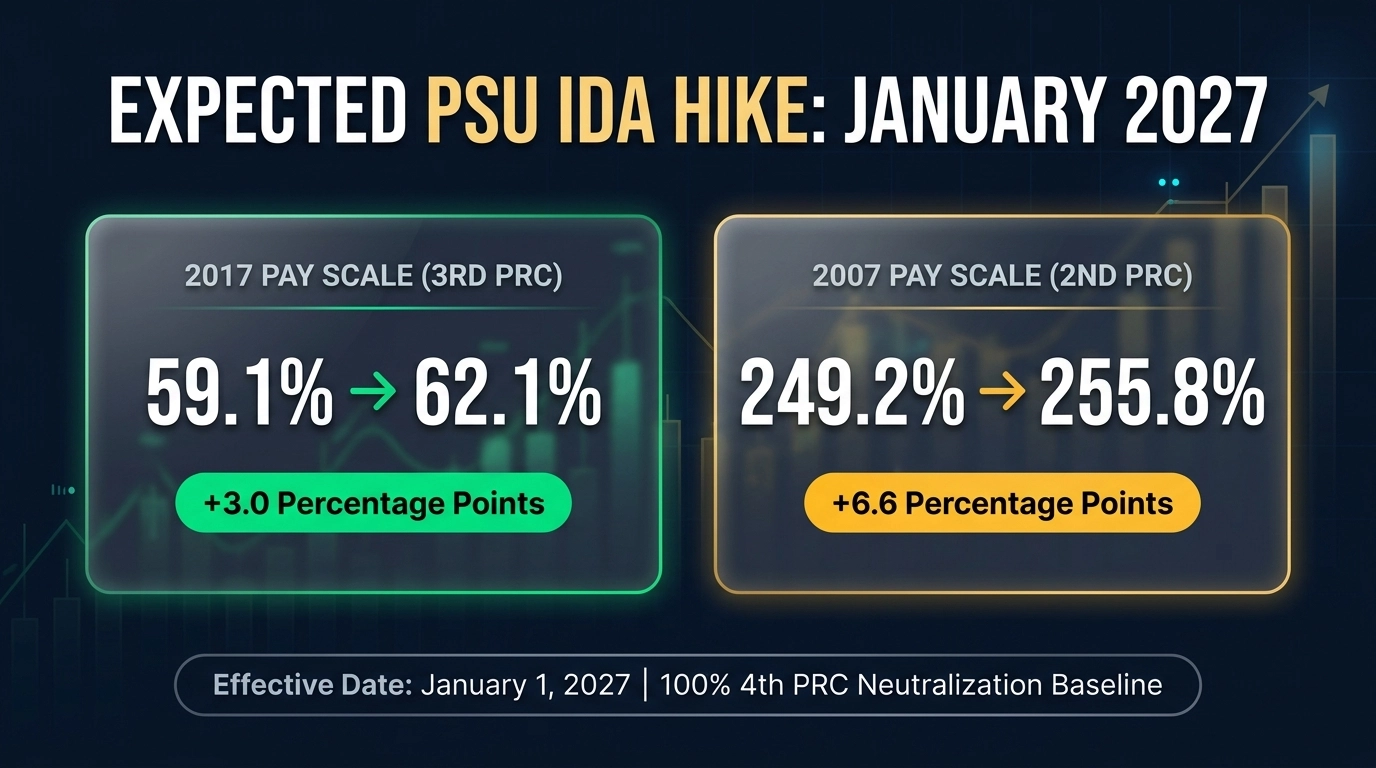
Based on late-2026 inflation trends, you can expect roughly a 3.0 percentage point jump on 2017 pay scales (pushing IDA from 59.1% to 62.1%) and a 6.6 to 6.7 point jump on 2007 scales (lifting IDA from 249.2% to 255.8% or 255.9%).
PSU IDA Hike (Jan 2027) & 4th PRC Salary Calculator
Calculate your expected January 1, 2027 IDA jump across 2017, 2007 (BSNL/MTNL), and 1997 scales, or test your 4th PRC Basic & Gross Pay fixation.
How Your Quarterly IDA Is Calculated (And Why Online Calculators Miss by 0.1%)
Unlike Central Government employees, who only get a Dearness Allowance hike twice a year in January and July based on a slow 12-month price average, PSU executives and supervisors get quarterly updates on January 1, April 1, July 1, and October 1.
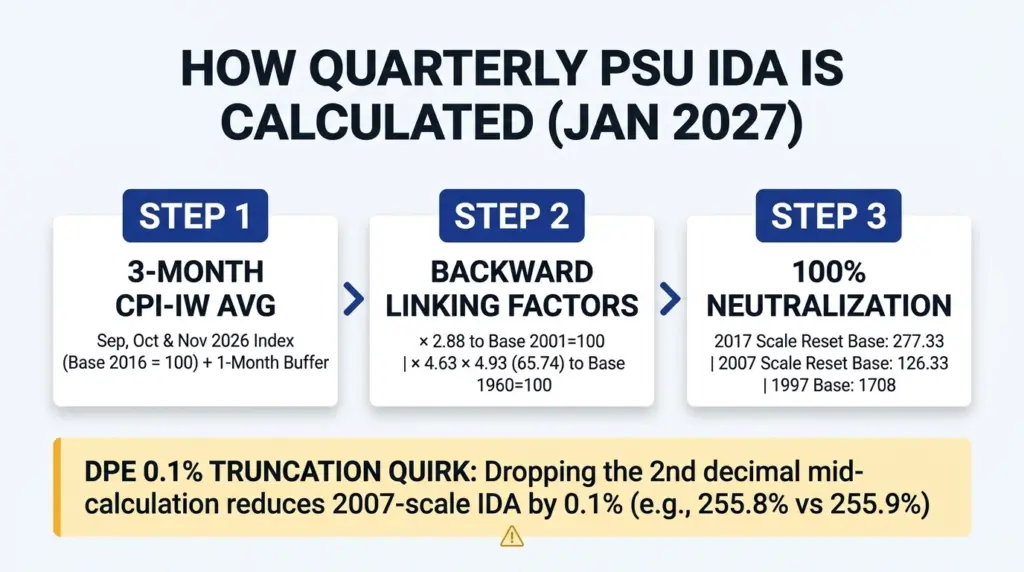
Every three months, the Department of Public Enterprises (DPE) looks at the All India Consumer Price Index for Industrial Workers (AICPI-IW), a monthly shopping-basket tracker compiled from 317 markets across 88 industrial centers by the Labour Bureau. To give statisticians a one-month buffer to gather receipts, your January 1, 2027 IDA rate is locked in strictly by the three-month average of September, October, and November 2026.
Here is where the math gets a bit quirky. The Labour Bureau tracks prices using a 2016 baseline (where 2016 equals 100). But PSU salary scales were built on older price baselines. To bridge the gap, DPE multiplies the current three-month average by an official conversion number (called a linking factor) of 2.88 to translate it back to the 2001 baseline.
For even older 1997, 1992, and 1987 pay scales, DPE chains two more multipliers together (4.63 and 4.93, which equals 65.738592 from the 2016 index) to reach the 1960 baseline.
Once converted, DPE gives you 100% dollar-for-dollar inflation protection above the price level that existed when your pay scale started:
- 2017 Pay Scale (3rd PRC): Compares the converted 2001-base average against 277.33 (the price level when IDA was reset to 0% on January 1, 2017).
- 2007 Pay Scale (2nd PRC): Compares the same converted average against 126.33 (the January 1, 2007 reset point).
- 1997 and 1987 Scales: The 1997 scale measures percentage growth above 1708 on the 1960 index, while the old 1987 scale pays a flat ₹2.00 per point shift. (DPE stopped publishing 1992-scale tables in February 2026 because survey records showed no PSU had active staff left on them, though any company can still request a custom calculation if needed.)
Most people don’t realize why their personal spreadsheet often disagrees with the official DPE order by 0.1% on the 2007 scale. Right to Information (RTI) records obtained by retired BSNL executives revealed that DPE frequently chops off the second decimal place of the three-month average before finishing the math.
In January, April, and July 2026, that single-decimal truncation shaved 0.1 percentage points off the 2007-scale payout (yielding 236.7%, 238.3%, and 241.7% instead of 236.8%, 238.4%, and 241.8%). Then again, in its official October 2026 IDA order, DPE kept the fuller conversion to notify 59.1% (2017 scale) and 249.2% (2007 scale).
| Effective Quarter | 3-Month CPI-IW Inputs (2016=100) | Avg 1960 Index (DPE Order) | 2017 Pay Scale (3rd PRC) | 2007 Pay Scale (2nd PRC / BSNL) | 1997 Pay Scale | 1992 Pay Scale (Up to ₹3,500 Slab)* | 1987 Pay Scale (Flat Rate) |
|---|---|---|---|---|---|---|---|
| Jan 2025 | Sep–Nov 2024 (143.3, 144.5, 144.5) | Not in archive | 49.6% | 228.5% | 454.6% | Order issued Jan 28, 2025 | Order issued Jan 28, 2025 |
| Apr 2025 | Dec 2024–Feb 2025 (Feb: 142.8) | Not in archive | Not in archive | Not in archive | Not in archive | Not in archive | Not in archive |
| Jul 2025 | Mar–May 2025 (143.0, 143.5, 144.0) | 9433 | ~49.0% (formula estimate) | ~227.1% (formula estimate) | ~452.3% (formula estimate) | 758.3% | ₹17,456 |
| Oct 2025 | Jun–Aug 2025 (145.0, 146.5, 147.1) | 9611 | 51.8% | 233.2% | 462.7% | 774.5% | ₹17,812 |
| Jan 2026 | Sep–Nov 2025 (147.3, 147.7, 148.2) | 9710 | 53.4% | 236.7% | 468.5% | Discontinued | ₹18,010 |
| Apr 2026 | Dec 2025–Feb 2026 (148.2, 148.6, 148.5) | 9756 | 54.1% | 238.3% | 471.2% | Discontinued | ₹18,102 |
| Jul 2026 | Mar–May 2026 (149.1, 149.9, 150.8) | 9854 | 55.7% | 241.7% | 476.9% | Discontinued | ₹18,298 |
| Oct 2026 | Jun–Aug 2026 (151.9, 153.2, 154.4) | 10069 | 59.1% | 249.2% | 489.5% | Discontinued | ₹18,728 |
*Note: For higher 1992 pay bands (₹3,501–₹6,500, ₹6,501–₹9,500, and above ₹9,500), DPE notified 568.7%, 455.0%, and 379.1% in July 2025, rising to 580.9%, 464.7%, and 387.2% in October 2025.
Three Scenarios for January 2027 Based on Late-2026 Inflation
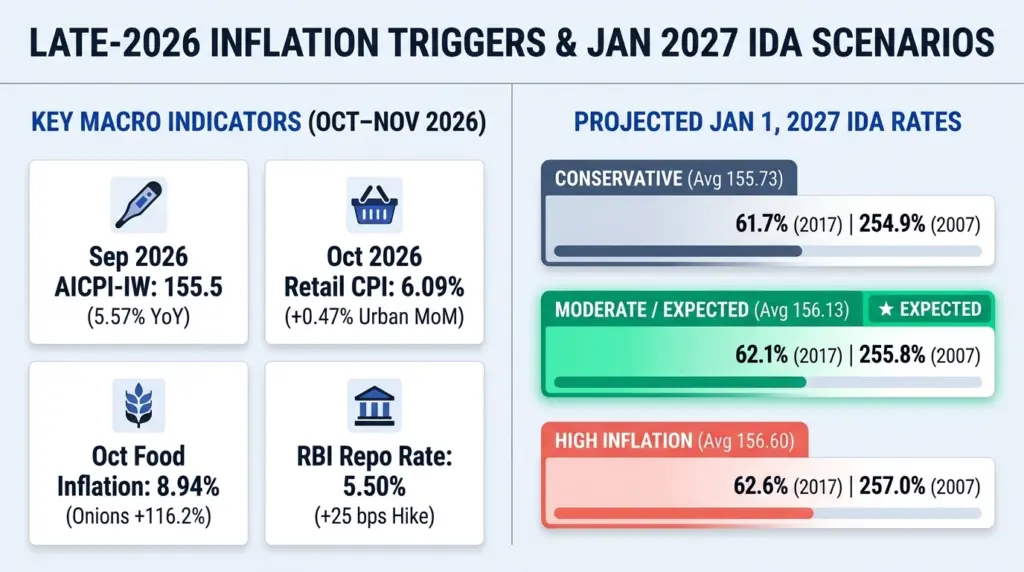
After a tiny dip to 148.5 in February 2026, factory-worker inflation climbed for seven straight months, reaching 155.5 (5.57% annual inflation) in the Labour Bureau’s September 2026 CPI-IW release. We are still waiting on the October and November readings (the Labour Bureau typically drops the November number on December 31).
Still, two major economic reports give us a clear preview of where those numbers are headed. First, the October 2026 retail inflation report from the Statistics Ministry (MoSPI) showed overall inflation jumping from 5.54% in September to 6.09% in October, with urban prices rising 0.47% in a single month (from 108.71 to 109.22).
Food inflation hit 8.94%, driven by runaway kitchen staples: onions soared 116.22% year-on-year, garlic jumped 60.74%, ginger rose 48.32%, and lemons climbed 47.30%, which easily outweighed cheaper potatoes (-14.24%) and cauliflower (-10.57%). Second, the Reserve Bank of India raised its benchmark repo interest rate by 25 basis points to 5.50% in early October 2026 (its first hike since February 2023), citing West Asia tensions, crude oil topping $100 a barrel, and a monsoon 12.6% below normal, projecting headline inflation to peak around 6.0% in the October–December quarter.
| Scenario (Sep 2026 Actual = 155.5) | Assumed Oct & Nov 2026 CPI-IW | 3-Month Average (2016=100) | Converted Average (2001=100)* | Projected 2017 Scale IDA (vs 59.1%) | Projected 2007 Scale IDA (vs 249.2%) | Projected 1997 Scale IDA (vs 489.5%) |
|---|---|---|---|---|---|---|
| Conservative (Modest Oct rise + winter veggie dip) | Oct: 155.9, Nov: 155.8 | 155.73 | 448.4 (1-dec) / 448.51 (2-dec) | 61.7% (+2.6 pp) | 254.9% to 255.0% (+5.7 to +5.8 pp) | 499.2% to 499.4% (+9.7 to +9.9 pp) |
| Moderate / Expected (Tracks +0.47% urban CPI rise) | Oct: 156.3, Nov: 156.6 | 156.13 | 449.5 (1-dec) / 449.66 (2-dec) | 62.1% (+3.0 pp) | 255.8% to 255.9% (+6.6 to +6.7 pp) | 500.7% to 500.9% (+11.2 to +11.4 pp) |
| High Inflation (Persistent food & oil pressure) | Oct: 156.7, Nov: 157.6 | 156.60 | 451.0 (1-dec) / 451.01 (2-dec) | 62.6% (+3.5 pp) | 257.0% (+7.8 pp) | 502.7% to 502.8% (+13.2 to +13.3 pp) |
*Note: Lower numbers in the 2007 and 1997 columns use single-decimal truncation before multiplying by 2.88; higher numbers use standard two-decimal math. Under the Moderate path, the 2017 scale lands on 62.1% either way.
Why the January 2027 IDA Rate Locks In Your Future 4th PRC Basic Pay
There is a lot of confusion right now about how the upcoming pay commission affects PSU workers. Roughly 96% of CPSE staff follow IDA scales and are completely excluded from the 8th Central Pay Commission for PSU and bank employees, which was set up on November 3, 2025 for 50 lakh central government staff and 68 lakh pensioners (with its report due around May 2027). You can also see how unionized bank negotiations differ in this breakdown of the 13th Bipartite Settlement vs. the 8th Pay Commission.
In a March 9, 2026 parliamentary reply (Lok Sabha Unstarred Question No. 2538), Minister of State for Finance Pankaj Chaudhary stated plainly that the government has no proposal under consideration to set up a separate institutional Pay Revision Committee for non-executive staff and below-Board officers in CPSEs.
While officer groups like the IndianOil Officers’ Association (IOOA) and the National Confederation of Officers’ Associations (NCOA) reported a positive July 2026 meeting with the DPE Secretary regarding a 4th PRC pay revision guide for PSUs in 2027, no official committee exists yet.
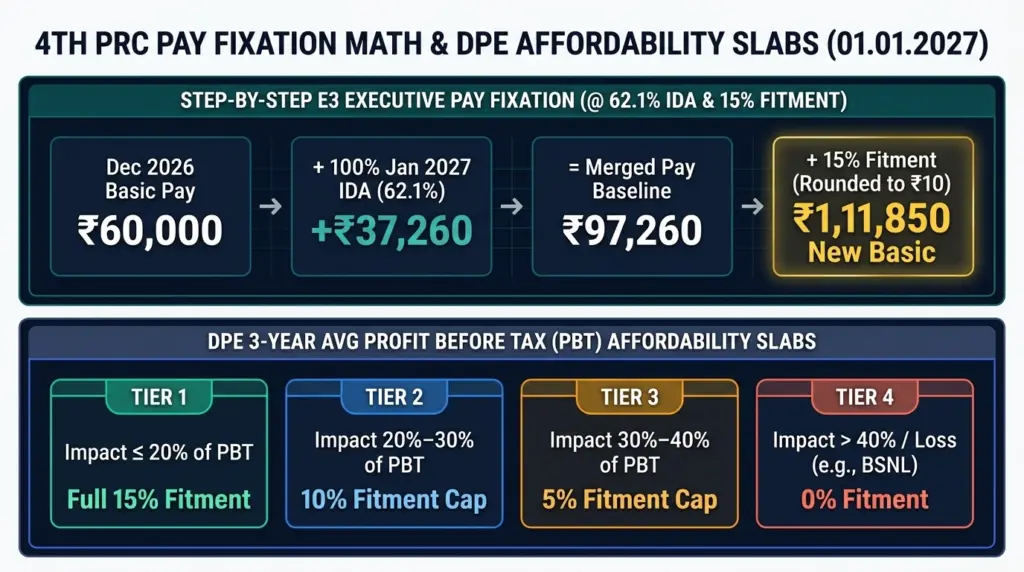
That said, whether the 4th PRC order arrives late in 2027 or in 2028, it will take effect retrospectively from January 1, 2027. And under DPE rules, whatever your IDA percentage is on January 1, 2027 gets permanently folded (merged 100%) into your Basic Pay before your raise percentage, called the fitment factor, is applied and rounded up to the next ₹10. (You can test your own basic pay numbers on the 8th Pay Commission and PSU salary calculator.)
At the expected 62.1% IDA rate, merging IDA multiplies your December 2026 Basic Pay by 1.621. Adding a 10% fitment benefit creates a total Basic Pay multiplier of 1.7831x (ranging from 1.7787x at 61.7% IDA to 1.7886x at 62.6% IDA). A 15% fitment (matching the 2017 benchmark) gives 1.8642x (1.8596x to 1.8699x), while a 20% fitment yields 1.9452x (1.9404x to 1.9512x).
| CPSE Grade (2017 Scale) | Current Basic Pay (Dec 31, 2026) | Projected Jan 2027 IDA @ 62.1% | Merged Pay (Basic + 100% IDA) | New Basic @ 10% Fitment (Next ₹10) | New Basic @ 15% Fitment (Next ₹10) | New Basic @ 20% Fitment (Next ₹10) |
|---|---|---|---|---|---|---|
| E0 (Entry Level) | ₹30,000 | ₹18,630 | ₹48,630 | ₹53,500 | ₹55,930 | ₹58,360 |
| E1 (Scale Min) | ₹40,000 | ₹24,840 | ₹64,840 | ₹71,330 | ₹74,570 | ₹77,810 |
| E2 (Scale Min) | ₹50,000 | ₹31,050 | ₹81,050 | ₹89,160 | ₹93,210 | ₹97,260 |
| E3 (Scale Min) | ₹60,000 | ₹37,260 | ₹97,260 | ₹1,06,990 | ₹1,11,850 | ₹1,16,720 |
| E5 (DGM) | ₹90,000 | ₹55,890 | ₹1,45,890 | ₹1,60,480 | ₹1,67,780 | ₹1,75,070 |
| E8 (General Manager) | ₹1,20,000 | ₹74,520 | ₹1,94,520 | ₹2,13,980 | ₹2,23,700 | ₹2,33,430 |
| Director (Schedule A) | ₹1,80,000 | ₹1,11,780 | ₹2,91,780 | ₹3,20,960 | ₹3,35,550 | ₹3,50,140 |
What does this mean for actual take-home pay? Take an E3 executive on ₹60,000 Basic Pay. If you hold House Rent Allowance (HRA) at a baseline 24% (₹14,400) and tax-friendly “cafeteria perks” (flexible allowances for fuel, medical, or staff) at 35% (₹21,000), pre-revision January 2027 gross pay at 62.1% IDA (₹37,260) is ₹1,32,660. (Fact-check note: Because PSU IDA crossed 50% back in late 2025, DPE’s current HRA city classification rules actually pay 30% HRA (or ₹18,000) in Class X metro cities right now, putting real pre-revision gross pay at ₹1,36,260 before HRA resets to 24% when IDA zeroes out).
Once a 15% fitment lifts Basic Pay to ₹1,11,850 at 0% IDA, 24% HRA jumps to ₹26,844 and 35% perks jump to ₹39,147.50, lifting post-revision gross pay to ₹1,77,841.50 (+₹45,181.50/month or +34.06% over the 24%-HRA baseline).
Two DPE policy rules can limit that payout, though:
- The Affordability Clause: A PSU can only grant the full 15% fitment if the extra annual salary cost stays under 20% of its average Profit Before Tax (PBT) over the last three years. If the cost hits 20% to 30% of PBT, fitment drops to 10%; between 30% and 40%, it drops to 5%; over 40% (or in loss-making companies), fitment is 0%. Audited FY 2025-26 filings show profitable giants easily clear the 20% bar, including IOCL (₹48,784 crore standalone PBT; ₹39,003.33 crore 3-year average giving ~₹7,801 crore in 20% headroom), BPCL (₹31,104 crore PBT), HPCL (₹22,907 crore), NTPC (₹22,556.93 crore), and BEL (₹8,075.04 crore).
- Cafeteria Perks Compression: In 2017, DPE cut the cafeteria perks cap from 50% down to 35% when Basic Pay jumped. If a future order trims perks from 35% to 25%, that E3 executive’s revised gross pay drops from ₹1,77,841.50 to ₹1,66,656.50 (+25.63% instead of +34.06%).
The BSNL and MTNL Standoff: Why 2007 Scales Jump Twice as Fast
While oil and power PSUs enjoy 2017 scales, employees and absorbed retirees of BSNL and MTNL remain stuck on 2007 (2nd PRC) scales. On August 12, 2026 (Lok Sabha Unstarred Question No. 4005), Minister of State for Communications Dr. Pemmasani Chandra Sekhar reiterated that BSNL cannot implement the 3rd PRC because it doesn’t meet DPE’s profitability rules. That freeze also covers MTNL, whose operations were handed over to BSNL under a 10-year agreement on January 1, 2025.
Even though a internal BSNL wage committee signed an agreement with unions on October 8, 2025 proposing new non-executive scales backdated to January 1, 2017 (like lifting NE-1 from ₹7,760–₹13,320 to ₹19,000–₹32,000 and NE-2 from ₹7,840–₹14,700 to ₹19,100–₹39,000 with shorter spans), the Telecom Ministry (DoT) hasn’t approved it.
That deadlock sparked union hunger fasts in October 2026, a November 11 meeting with Communications Minister Jyotiraditya Scindia, a planned All India Strike on November 20, 2026, and parallel pushback from executive group AIGETOA demanding an affordability waiver and standard E2/E3 scales.
The silver lining of being stuck on 2007 scales is quarterly IDA sensitivity. Because the 2007 base index (126.33) is less than half the 2017 base index (277.33), every 1-point rise in the 2001-base CPI lifts 2007 IDA by 0.792 percentage points compared to 0.361 points on 2017 scales (2.195 times faster). Under DPE rules, fractions of 50 paise and above round up to the next rupee:
| 2007 Scale Grade / Representative Tier | Basic Pay (2nd PRC) | Oct 2026 IDA @ 249.2% (Basic + IDA) | Conservative Jan 2027 @ 254.9%* (+5.7 pp) | Moderate / Expected Jan 2027 @ 255.8%* (+6.6 pp) | High Inflation Jan 2027 @ 257.0% (+7.8 pp) |
|---|---|---|---|---|---|
| Non-Exec NE-1 (Min) | ₹7,760 | ₹19,338 (₹27,098) | ₹19,780 (+₹442/mo | +₹5,304/yr) | ₹19,850 (+₹512/mo | +₹6,144/yr) | ₹19,943 (+₹605/mo | +₹7,260/yr) |
| Non-Exec NE-7 (Min) | ₹10,900 | ₹27,163 (₹38,063) | ₹27,784 (+₹621/mo | +₹7,452/yr) | ₹27,882 (+₹719/mo | +₹8,628/yr) | ₹28,013 (+₹850/mo | +₹10,200/yr) |
| Mid-Tier Non-Exec (NE-9: ₹13,600–₹25,420) | ₹20,000 | ₹49,840 (₹69,840) | ₹50,980 (+₹1,140/mo | +₹13,680/yr) | ₹51,160 (+₹1,320/mo | +₹15,840/yr) | ₹51,400 (+₹1,560/mo | +₹18,720/yr) |
| Executive Tier A | ₹30,000 | ₹74,760 (₹1,04,760) | ₹76,470 (+₹1,710/mo | +₹20,520/yr) | ₹76,740 (+₹1,980/mo | +₹23,760/yr) | ₹77,100 (+₹2,340/mo | +₹28,080/yr) |
| Executive Tier B | ₹45,000 | ₹1,12,140 (₹1,57,140) | ₹1,14,705 (+₹2,565/mo | +₹30,780/yr) | ₹1,15,110 (+₹2,970/mo | +₹35,640/yr) | ₹1,15,650 (+₹3,510/mo | +₹42,120/yr) |
*Note: If DPE uses two-decimal math (255.0% or 255.9%), add another 0.1% of Basic Pay per month (e.g., +₹30/month on ₹30,000 Basic).
What You Should Watch For Next
You don’t need to file any paperwork to claim your quarterly IDA hike, as HR payroll teams and union representatives handle ministry endorsements behind the scenes. Here is what you can practically expect and track over the next few weeks:
- December 31, 2026: Watch for the Labour Bureau’s November CPI-IW press release, which locks in the exact three-month average.
- Late January 2027: While DPE orders cover executives and non-unionized supervisors first, individual CPSEs extend the exact same rate to unionized workers via company circulars. Expect the official DPE order around the third or fourth week of January, with full arrears paid back to January 1.
- For BSNL/MTNL Staff & Retirees: Expect a bureaucratic lag. Even though retiree Dearness Relief comes out of the central government budget, DoT frequently delays sign-off orders (for instance, the January 2026 hike wasn’t cleared by DoT until May 21, 2026, and the October 2026 endorsement was still pending DoT sign-off in mid-November). Check your salary or pension slip once DoT issues its clearance to make sure your backdated arrears are credited properly.
Leave a Reply