
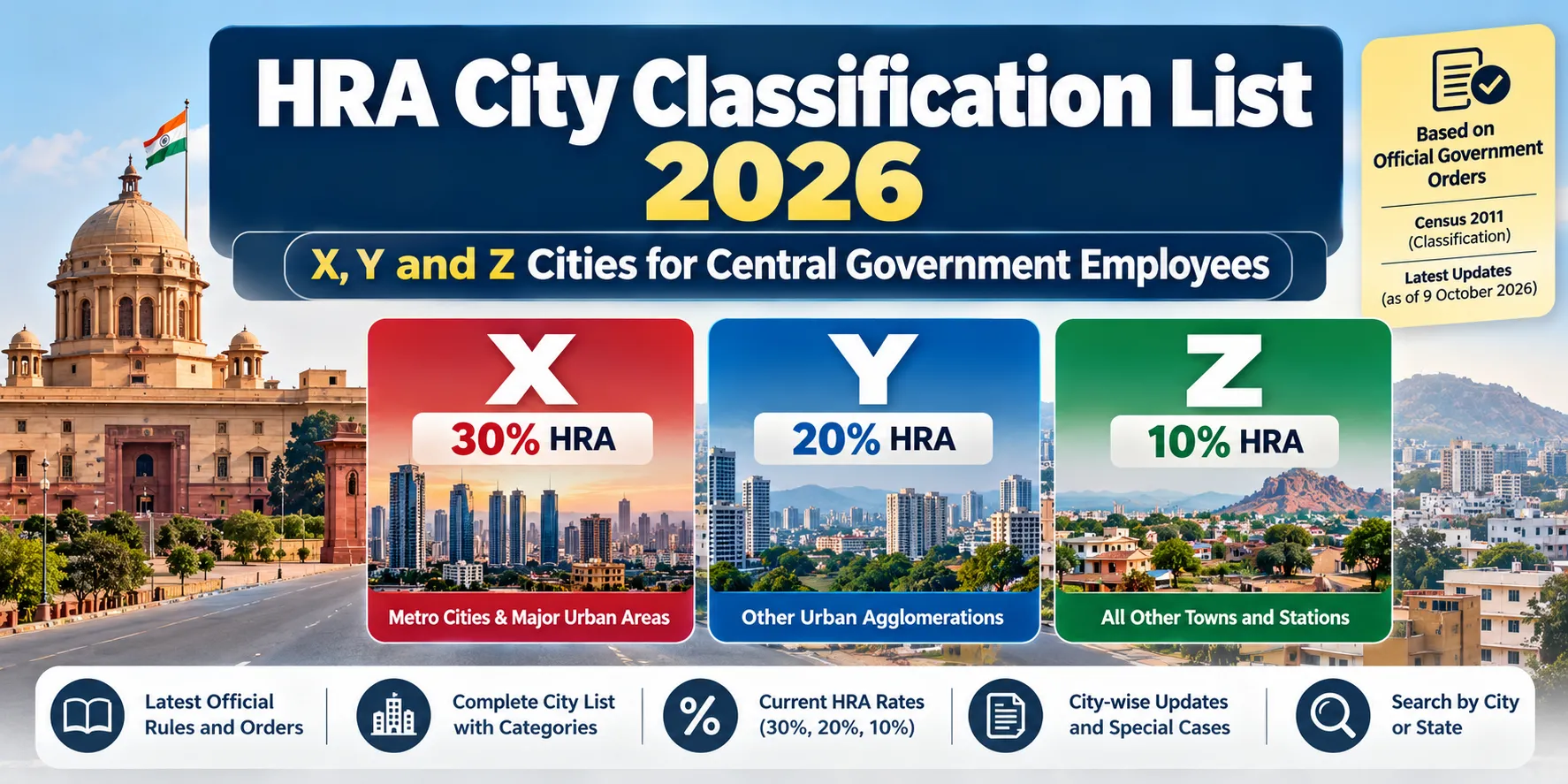
How HRA Works in 2026: No Guesswork, Just Clear Rules
Figuring out your House Rent Allowance should be straightforward. Still, government employees regularly run into outdated rate charts from 2017 or stumble across websites claiming that a brand-new census list redrew the map for 2026. That creates unnecessary worry during transfers.
The reality is simpler than online rumors suggest. The official geographic classification of Indian cities still rests on the Ministry of Finance foundational city classification issued by the Department of Expenditure. Because the 2021 Census was postponed, no sweeping national reclassification has replaced that framework. Instead, what changed is the percentage you get. With Dearness Allowance firmly above 50%, every central employee receives the highest tier of HRA percentages allowed under current rules. You can review our detailed breakdown of X, Y, and Z classification rules to see how this fits into your broader salary slip.
Smart HRA Calculator (2026 Rules)
Check your exact monthly HRA, automatic floor protection, and transfer comparison in seconds.
Transfer Comparison Matrix for ₹35,400
All 3 TiersTransferring from a Class Z location to a Class X metro on this basic pay adds an extra ₹7,080 per month to your gross salary slip.
The 30%, 20%, and 10% Rates (Plus the Protection Floor)
Why your rate stepped up, and why lower pay levels are shielded from tiny payouts.
Back when the government implemented the original 7th Pay Commission HRA notification in July 2017, it replaced fixed, stagnant rates with a built-in inflation trigger. Instead of waiting ten long years for a raise, HRA was scheduled to climb automatically as living costs rose:
The Safety Net: Guaranteed Minimum Monthly Floors
What happens if someone enters service at Level 1 with a basic pay of ₹18,000 in a major metro? Ten percent or twenty percent of that amount might barely cover a fraction of actual urban rent.
To prevent junior staff from getting squeezed, the rules set a minimum monetary floor. No matter how low your basic pay is, your monthly HRA cannot drop below these absolute numbers:
Interactive City Directory: Look Up Your Posting
Type your station or city name to check its official tier and active allowance rate. Click any city to load it directly into the calculator above.
| City / Station | State / UT | Classification Area | Rate (2026) | Action |
|---|
Special Exceptions: NCR Satellites and Historical Protections
Why places like Noida and Gurugram get metro rates despite population counts.
Population alone does not always tell the whole story. Living in a satellite city right next to a national capital or state hub can be just as expensive as living in the city center. To keep things fair, the government maintains special geographic dispensations that elevate specific locations above their census brackets:
Noida, Gurugram (Gurgaon), Faridabad, and Ghaziabad do not have a standalone municipal population of 50 lakhs. Yet employees posted there receive full X-class (30%) HRA. This historical parity protects staff facing capital-city living expenses right on the border of Delhi.
Panchkula and SAS Nagar (Mohali) receive Y-class rates because of guaranteed parity with Chandigarh. Similarly, Jalandhar Cantt gets Y-class parity with Jalandhar city.
Locations such as Shillong, Port Blair, and the entire state of Goa are preserved at Y-class rates through explicit orders, recognizing high logistics and housing costs in remote or tourist zones.
When municipal territories expand, specific orders follow. In 2020, the Department of Expenditure officially upgraded Mathura-Vrindavan to Y-class, elevating it out of Z-category.
The 8-Kilometer Rule and the Transport Allowance Trap
Two common traps that cause people to calculate their allowances incorrectly.
1. Posted Just Outside the City Limits? The 8-Km Radius Rule
Government facilities are often built on the outskirts of major cities where land is available, such as ordnance factories, central universities, or research centers. If your office sits just outside municipal borders in an unclassified area, do you get stuck with the Z-class rate?
Not necessarily. Under Fundamental Rules (FRSR Part V), if your post lies within an 8-kilometer radius of the municipal limits of a classified X or Y city, and no government housing is provided, you can apply for the higher rate. The key requirement is a dependency certificate from the District Collector certifying that the outpost relies on the main city for essential services and housing. It requires local administrative paperwork, but it saves staff thousands of rupees each month.
2. Do Not Confuse HRA with Transport Allowance (TPTA)
This is by far the most common mistake made on online payroll calculators. People see the list of 19 Higher TPTA cities list and assume those are all X-class cities for HRA.
They are completely different lists governed by different rules:
- HRA X-Class: Exactly 8 major metropolitan Urban Agglomerations (plus specific NCR satellite orders).
- Higher Transport Allowance: Covers 19 cities, including places like Patna, Lucknow, Jaipur, Nagpur, and Surat. Those cities get higher travel allowances, but for housing, they remain Y-class (20%) cities!
What About the 8th Pay Commission?
Central government employee unions have submitted memoranda asking for HRA to be revised to 40%, 35%, and 30% under the upcoming commission. Some staff wonder if those rates are already in effect.
They are not. While the government issued the cabinet approval of the 8th Pay Commission terms in late 2025 under Justice Ranjana Prakash Desai, the commission has an 18-month reporting mandate running until mid-2027. You can keep track of official milestones in our timeline guide to 8th Pay Commission key dates and timeline.
Until the commission submits its final report and the Union Cabinet accepts it, the 30%, 20%, and 10% caps will remain in place. Even discussions about merging DA into basic pay or broader upcoming 8th Pay Commission changes will not alter HRA until formal gazette orders are published. Similar guidelines apply to autonomous bodies and pay rules for central teachers.
The Takeaway for Your Next Paycheck
Double-checking your city classification takes only a minute, but it ensures your Drawing and Disbursing Officer (DDO) credits the right amount to your account every month. Remember three simple numbers: 30% for the 8 core metros and NCR, 20% for major urban centers, and 10% for everywhere else, backed by mandatory minimum floors so junior pay grades are never shortchanged. If you are posted in a newly formed suburb or within 8 kilometers of city limits, checking your dependency paperwork with your local office can make a very real difference in your take-home pay.