Walk into almost any railway junction or village post office right now and you will hear the same assumption: once the 8th Central Pay Commission kicks in, everyone’s pay goes up together. It sounds reasonable, especially when salary charts are flying around WhatsApp every week.
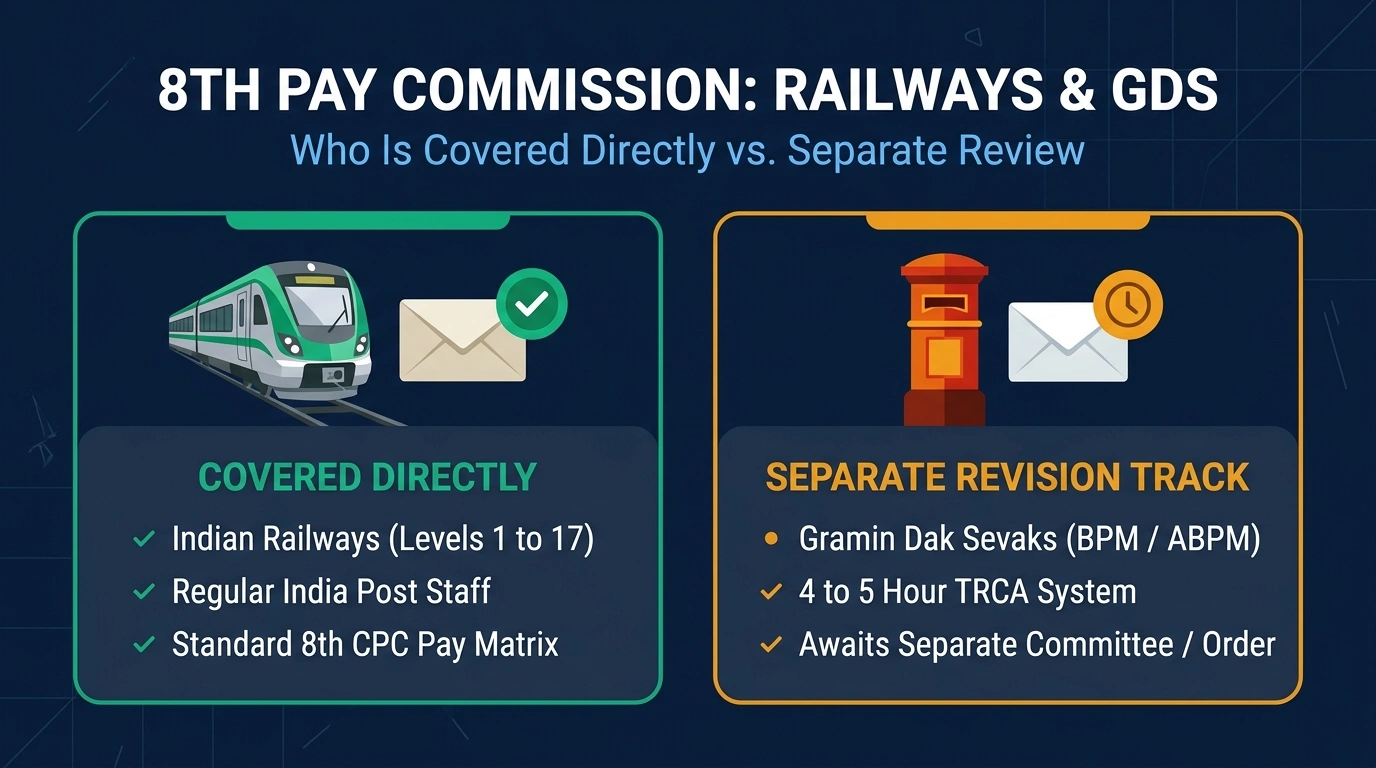
The actual rules work very differently. Regular Indian Railways workers and full-time Department of Posts staff are officially covered by the new commission. Village-level Gramin Dak Sevaks (GDS) are not automatically included, and history shows they usually wait years for a separate wage committee.
On top of that, as of late November 2026, the government has not approved a single fitment factor or final hike yet.
Who is covered (and who is left waiting)
The Union Cabinet cleared the 8th Pay Commission’s Terms of Reference on October 28, 2025, and the Finance Ministry formally notified the three-member panel on November 3, 2025. Headed by retired Justice Ranjana Prakash Desai alongside Prof. Pulak Ghosh and Member-Secretary Pankaj Jain, the commission has 18 months to submit its recommendations. That puts the deadline in early May 2027.
While the official Cabinet release from PIB noted that the ten-year cycle normally points to a January 1, 2026 effective date, no binding implementation date or pay table has been finalized.
Under the 8th CPC Gazette notification, regular Central Government employees sit directly inside the commission’s mandate. That includes all regular Indian Railways personnel, covering more than 11.4 lakh non-gazetted staff alongside Group A and Group B officers. Track Maintainers, Pointsmen, Assistant Loco Pilots, Loco Pilots, Train Managers, Station Masters, and engineers are all in. (Railways abolished Group D posts years ago after the 6th CPC, folding those workers into Level 1.)
Regular India Post employees are directly covered too, from Multi-Tasking Staff, Postmen, and Mail Guards up through Postal Assistants, Sorting Assistants, Inspectors, and Superintendents.
Coverage lines in public-sector pay are stricter than most people realize. Just as bank and PSU employees remain outside the 8th Pay Commission, with public-sector executives following separate cycles like the 4th PRC pay scale structure and industrial allowance updates tracked on a PSU IDA January 2027 calculator, Gramin Dak Sevaks also operate outside regular civil service pay rules. In fact, the 8th CPC’s mandate asks the panel to compare Central Government salaries with PSU and private-sector pay while staying completely silent on GDS.
That silence confuses a lot of postal workers because of a well-known court ruling. Back in 1977, the Supreme Court confirmed that village postal workers hold a “civil post,” meaning the government cannot fire them arbitrarily without a fair constitutional inquiry.
Still, holding a civil post for job-termination protection does not make someone a regular full-time civil servant. GDS Branch Postmasters (BPM), Assistant Branch Postmasters (ABPM), and Dak Sevaks work 4 to 5 hours a day under separate 2020 engagement rules, serve until age 65 instead of 60, and declare an alternative source of income. Because of that legal split, Pay Commission matrices have never applied to them automatically.
What the 8th CPC could mean for Railway and regular Postal pay
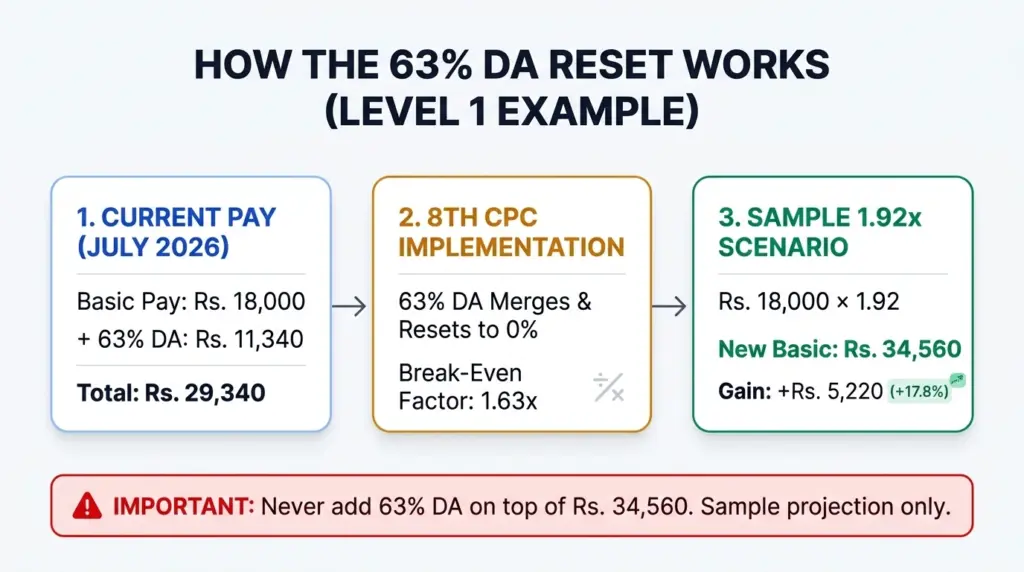
Before looking at any salary projection, clear up the biggest math trap circulating online: Dearness Allowance (DA) resets to zero when a new Pay Commission starts. Central Government DA stands at 63% from July 1, 2026, up three percentage points from January. When a new pay matrix takes effect, that 63% DA gets folded into the revised Basic Pay. You never add 63% DA on top of the new figure.
Take a Level 1 Track Maintainer or postal MTS earning ₹18,000 Basic Pay today. With 63% DA, their current Basic plus DA totals ₹29,340. If a hypothetical 1.92x multiplier applied, their new Basic Pay would be ₹34,560, a gain of ₹5,220 (about 17.8%) over current Basic plus DA, not ₹34,560 plus another 63%. Any multiplier below 1.63x would actually sit below what staff already draw today.
To see how different multipliers behave, you can test your own grade on the 8th Pay Commission salary calculator or read how 8th Pay Commission fitment factor estimates work. Remember, the numbers below are strictly sample scenarios, not official rates.
| Verified Pay Level and Sample Roles | Current Entry Basic | Basic + 63% DA (July 2026) | At 1.92x | At 2.28x | At 2.57x | At 2.86x |
| Level 1 (Track Maintainer Gr-IV, MTS) | ₹18,000 | ₹29,340 | ₹34,560 | ₹41,040 | ₹46,260 | ₹51,480 |
| Level 2 (Assistant Loco Pilot, TM Gr-III) | ₹19,900 | ₹32,437 | ₹38,208 | ₹45,372 | ₹51,143 | ₹56,914 |
| Level 3 (Postman, Mail Guard) | ₹21,700 | ₹35,371 | ₹41,664 | ₹49,476 | ₹55,769 | ₹62,062 |
| Level 4 (Postal/Sorting Asst., Sr. ALP) | ₹25,500 | ₹41,565 | ₹48,960 | ₹58,140 | ₹65,535 | ₹72,930 |
| Level 5 (Goods Train Manager, Tech Gr-I) | ₹29,200 | ₹47,596 | ₹56,064 | ₹66,576 | ₹75,044 | ₹83,512 |
| Level 6 (Station Master, JE, Loco Pilot) | ₹35,400 | ₹57,702 | ₹67,968 | ₹80,712 | ₹90,978 | ₹1,01,244 |
| Level 7 (SSE, Inspector of Posts) | ₹44,900 | ₹73,187 | ₹86,208 | ₹1,02,372 | ₹1,15,393 | ₹1,28,414 |
| Level 9 (Postal Superintendent Gr-B) | ₹53,100 | ₹86,553 | ₹1,01,952 | ₹1,21,068 | ₹1,36,467 | ₹1,51,866 |
One more reality check: Basic Pay is never your take-home pay. Income tax, 10% NPS or UPS pension deductions, Transport Allowance, and House Rent Allowance (HRA) all shift the final bank credit.
After DA crossed 50% in January 2024, HRA rates moved to 30%, 20%, and 10% depending on whether you are posted in an X, Y, or Z category city, which you can check against the 2026 HRA city classification list.
Railway allowances, bonuses, and union demands
For Indian Railways staff, Basic Pay is only half the story. Operational allowances run on their own tracks and require separate Railway Board orders long after a Cabinet announcement.
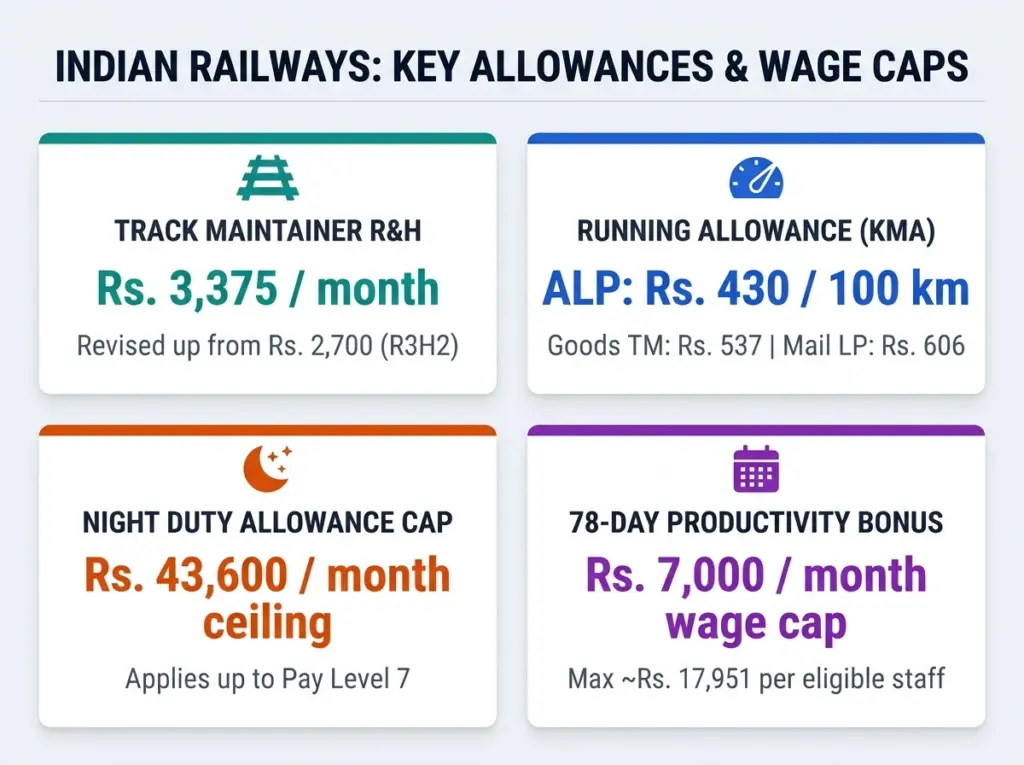
Look at how slow those follow-up orders can be. When DA crossed 50% on January 1, 2024, designated allowances rose 25% via a June 2024 circular, lifting the monthly Risk and Hardship Allowance for Track Maintainers from ₹2,700 to ₹3,375. Yet Running Staff waited over two years for their distance-based Kilometreage Allowance (KMA) order, which finally arrived on March 20, 2026 (backdated to January 2024). Under those revised rates, Assistant Loco Pilots earn ₹430 per 100 km, Goods Train Managers earn ₹537, and Mail/Express Loco Pilots earn ₹606.
Running Staff also hear a lot about the “30% pay element,” and people regularly mix it up with monthly cash. It is not a flat 30% bonus paid alongside KMA. Instead, it works as an accounting uplift built into Basic Pay during promotions, transfers to stationary jobs, and Night Duty Allowance math.
Higher Basic Pay under the 8th CPC will automatically lift the rupee value of that 30% element, while per-kilometre KMA rates will wait for a fresh allowance review and new Railway Board orders.
Two strict caps still frustrate railway workers today:
- Night Duty Allowance covers eligible non-gazetted staff up to Level 7, yet the formula caps monthly Basic Pay at ₹43,600. A Level 7 Senior Section Engineer drawing ₹44,900 gets calculated on ₹43,600 instead, coming out to ₹1,777 for 30 night hours at 63% DA.
- Productivity Linked Bonus uses an even tighter cap. On October 14, 2026, the Cabinet approved 78 days of bonus worth ₹2,009.61 crore for 11,40,770 non-gazetted railway staff, as confirmed in the Cabinet PLB announcement. Even if a Track Maintainer earns ₹29,340 with DA, the bonus formula caps monthly wages at ₹7,000, leaving the payout near ₹17,951 instead of roughly ₹75,244.
Major federations are pushing back hard. In Delhi oral hearings through October 2026 and written memorandums, AIRF and NFIR demanded fitment factors between 3.68x and 3.86x, removal of the ₹43,600 night-duty ceiling, upgraded Risk and Hardship slabs, and parity between Track Maintainers and Technicians.
Postal unions like NFPE and FNPO have submitted their own restructuring and minimum-pay proposals. Negotiating those demands with the Commission is the unions’ job, and it helps to keep a clear head: none of these proposals has been accepted by the government.
Gramin Dak Sevaks: current TRCA, DA parity, and likely revision paths
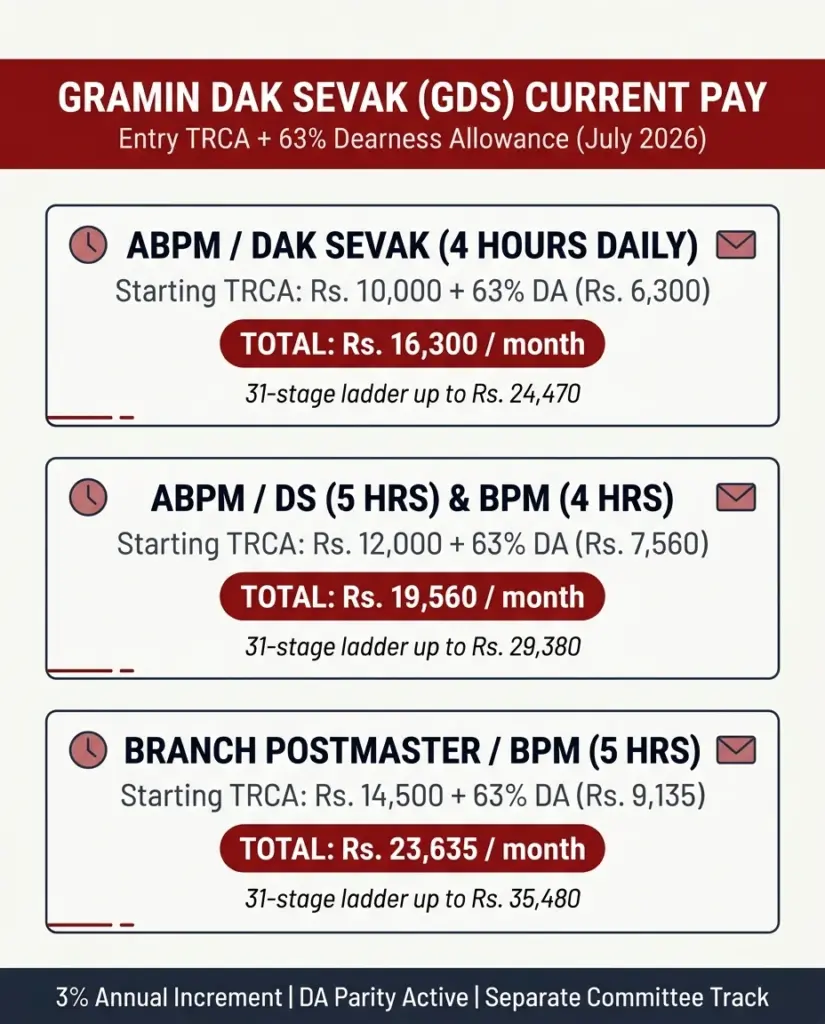
Instead of a Pay Matrix, Gramin Dak Sevaks earn Time Related Continuity Allowance (TRCA), calibrated to 4-hour or 5-hour workdays. Many people assume ₹10,000, ₹12,000, and ₹14,500 are flat fixed salaries. They are actually starting Stage 1 rates on 31-stage ladders that grow 3% every year, supported by a 2024 financial upgradation scheme after 12, 24, and 36 years of continuous work.
A 4-hour ABPM or Dak Sevak climbs from ₹10,000 to ₹24,470, a 5-hour ABPM or 4-hour BPM runs from ₹12,000 to ₹29,380, and a 5-hour BPM runs from ₹14,500 to ₹35,480.
The one area where GDS already have full parity is Dearness Allowance. India Post extends Central Government DA hikes to GDS at the exact same percentage. Following the November 4, 2026 postal order, DA sits at 63% from July 2026, bringing starting TRCA plus DA to ₹16,300, ₹19,560, and ₹23,635.
GDS also receive universal benefits like 20 days of paid leave, up to ₹1.5 lakh in ex-gratia gratuity, ₹4,000 per year of service as severance, and matching ₹300 monthly contributions toward their discharge benefit fund.
Role-based extras apply on top, including ₹500 (or ₹250) monthly Composite Allowance for Branch Postmasters maintaining offices and Combined Duty Allowance when covering vacant village posts.
What if an 8th CPC multiplier were applied directly to entry TRCA slabs with 63% DA resetting to zero? Again, no order guarantees this, so treat these numbers purely as math illustrations:
| GDS Entry TRCA Slab | Current TRCA + 63% DA | At 1.92x | At 2.28x | At 2.57x | At 2.86x |
| ₹10,000 (ABPM / Dak Sevak, 4 hrs) | ₹16,300 | ₹19,200 | ₹22,800 | ₹25,700 | ₹28,600 |
| ₹12,000 (ABPM / DS 5 hrs; BPM 4 hrs) | ₹19,560 | ₹23,040 | ₹27,360 | ₹30,840 | ₹34,320 |
| ₹14,500 (BPM, 5 hrs) | ₹23,635 | ₹27,840 | ₹33,060 | ₹37,265 | ₹41,470 |
History gives the clearest picture of what happens next. During both the 6th CPC (Nataraja Murti Committee, implemented October 2009) and the 7th CPC (detailed in the Parliamentary annexure on the Kamlesh Chandra Committee, implemented June 2018), India Post set up dedicated one-man committees after the main Pay Commission process.
Those rollouts arrived 14 to 29 months behind regular staff cycles. Even so, both cycles protected arrears back to the January 1, 2006 and January 1, 2016 benchmark dates, including a 2.57x lump-sum arrears formula for 2016 to 2018.
With GDS unions like AIGDSU demanding full inclusion and no separate committee announced yet, three realistic paths sit ahead for 2027 to 2028. The government can follow precedent and appoint a fresh GDS committee after the 8th CPC report lands, which takes longer but updates allowances too.
It could issue a direct Cabinet order applying the 8th CPC fitment factor straight onto existing TRCA slabs to deliver cash faster. Or it could fold GDS into a common pay framework, though converting lakhs of part-time village roles into full-time pensionable posts carries a massive fiscal bill that makes direct regularisation the toughest sell.
What employees should actually watch next
Hold off on taking loans or planning big household purchases around viral fitment numbers. For now, your best move is simple: keep your pay slips, increment records, and service verification papers updated, and track real announcements directly on the 8th CPC official portal, Department of Expenditure site, and India Post circulars.
Formal pay-scale lobbying and legal representations belong with recognized staff federations, not individual employees. Keep an eye on May 2027 when the Commission’s 18-month reporting window closes, and watch closely for two decisions once Cabinet orders roll out: the final regular pay matrix, and whether Gramin Dak Sevaks get arrears protection back to January 1, 2026.
Leave a Reply